

Quick answer: Building an all-terrain wheelchair DIY is possible but rarely the right move. Parts alone run $3,000–5,000+, specialized tools (welding, CNC machining) are required, and you’re looking at 100+ hours of labor. Most DIY projects end up costing more than a production chair like the Motus ($4,500), with zero engineering testing and no warranty. If you have the skills and tools already, sure — otherwise, buy assembled.

Find your grant in 90 seconds
Answer 5–7 quick questions and we’ll narrow 50+ adaptive-equipment grants down to the ones you’re most likely to win.
Free. No email required. Plus a 30-min strategy call with Kenny if you want help applying.
Take the Grant Match Quiz →At Extreme Motus, we create wheelchairs tough enough to conquer the great outdoors. But I get the question at least once a week: “Can I build one myself?” So let’s walk through exactly what goes into an all-terrain wheelchair — and why DIY is harder than it looks.
Starting with Premium Materials
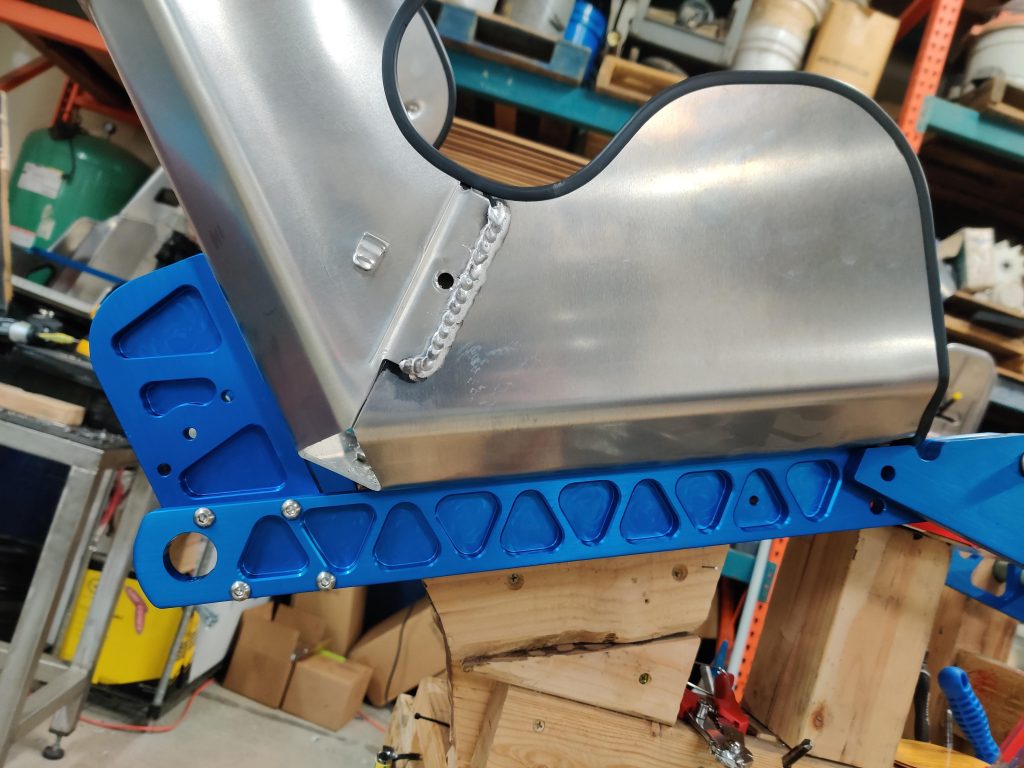
Each Extreme Motus wheelchair starts as a solid bar of aluminum — chosen for its lightweight, strength, and corrosion resistance. A quality aluminum billet for a wheelchair frame costs $200–$500 depending on size and grade. We cut these bars to the correct length using a precision band saw, ensuring they’re ready for the next stage of production.
If you’re sourcing DIY, you’ll also need fasteners (bolts, rivets, clips), welding or brazing materials, and finishes (powder coat or anodize). Budget another $300–$600 for these consumables alone.

Precision Crafting with CNC Technology
The heart of our manufacturing process is the CNC Mill — this is also where most DIY builders hit a wall. This advanced machine uses pre-programmed software to shape aluminum into the frame components with tolerances of 0.005 inches or better.
- What the CNC does: Carves out patterns in the frame for bungee attachment points, creates the seat mounting surfaces, and cuts weight-saving ports while maintaining structural integrity.
- The DIY problem: A used CNC mill costs $5,000–20,000 minimum. A full custom shop might charge $50–150/hour for CNC time. You could skip the CNC and hand-drill everything — but that takes 30+ hours per frame and your tolerances won’t be consistent.
- The Motus result: The chair weighs just 55 pounds, one of the lightest off-road wheelchairs available, thanks to those precision cutouts. DIY hand-drilled frames typically weigh 60–80 lbs with less structural confidence.
Welding, Brazing, and Structural Integrity
Once the aluminum is cut, you need to join the pieces. For wheelchairs, aluminum TIG welding is the standard — it’s stronger than riveting and cleaner than epoxy for stress-bearing joints. If you can TIG weld aluminum to aerospace standards, great. If not, you’re learning on the job with a component that will carry a human on rough terrain.
A professional TIG setup costs $1,500–3,000. Learning to weld well takes 40–100 hours. And here’s the honest part: nobody tests a DIY wheelchair frame the way manufacturers do — drop tests, fatigue tests, stress analysis. You build it, you use it, and you hope the welds hold. At Extreme Motus, every frame is engineered and load-tested before it ships.
Customization and Finishing Touches
Once the frame is structurally complete, the finish protects it. Powder coating (our standard) costs $200–400 for a custom job and requires access to a powder coat oven. Anodizing is another $150–300 and requires specialized chemicals. DIY options (spray paint, rust-oleum) cost less up front but wear off in a season on an outdoor chair.
High-Performance Seats
We use aluminum racing seats originally designed for race cars — this is a $300–800 component depending on size and material. The seat must wrap around the rider to prevent tip-over, bolt securely to the frame, and connect to the handlebars and brake systems. Off-the-shelf wheelchair seats are available for $200–500, but most don’t provide the lateral support an outdoor chair needs.
Wheels and Tires: Where DIY Gets Expensive
The Extreme Motus uses large balloon tires supplied by Wheeleez in California — these are the specialized tires that make the chair roll over sand, snow, mud, and gravel. A complete Wheeleez wheel assembly (rim + tire + bearing + axle) runs $600–800 per wheel. For a 3-wheel chair, that’s $1,800–2,400 in tires alone.
- Floating Capability: The oversized wheels are buoyant enough to keep the chair afloat in water — a design detail that’s harder to replicate with standard off-road tires.
- Air Pressure: Wheeleez tires run at 2–4 PSI, and the exact pressure matters for performance. Wrong pressure = the chair either sinks in soft terrain or rides harsh on hard ground.
- DIY alternative: You can buy standard all-terrain wheels for $200–500 each. They won’t float, they won’t handle sand as well, and they wear out faster — but they’re cheaper up front.
Brakes: The Safety System
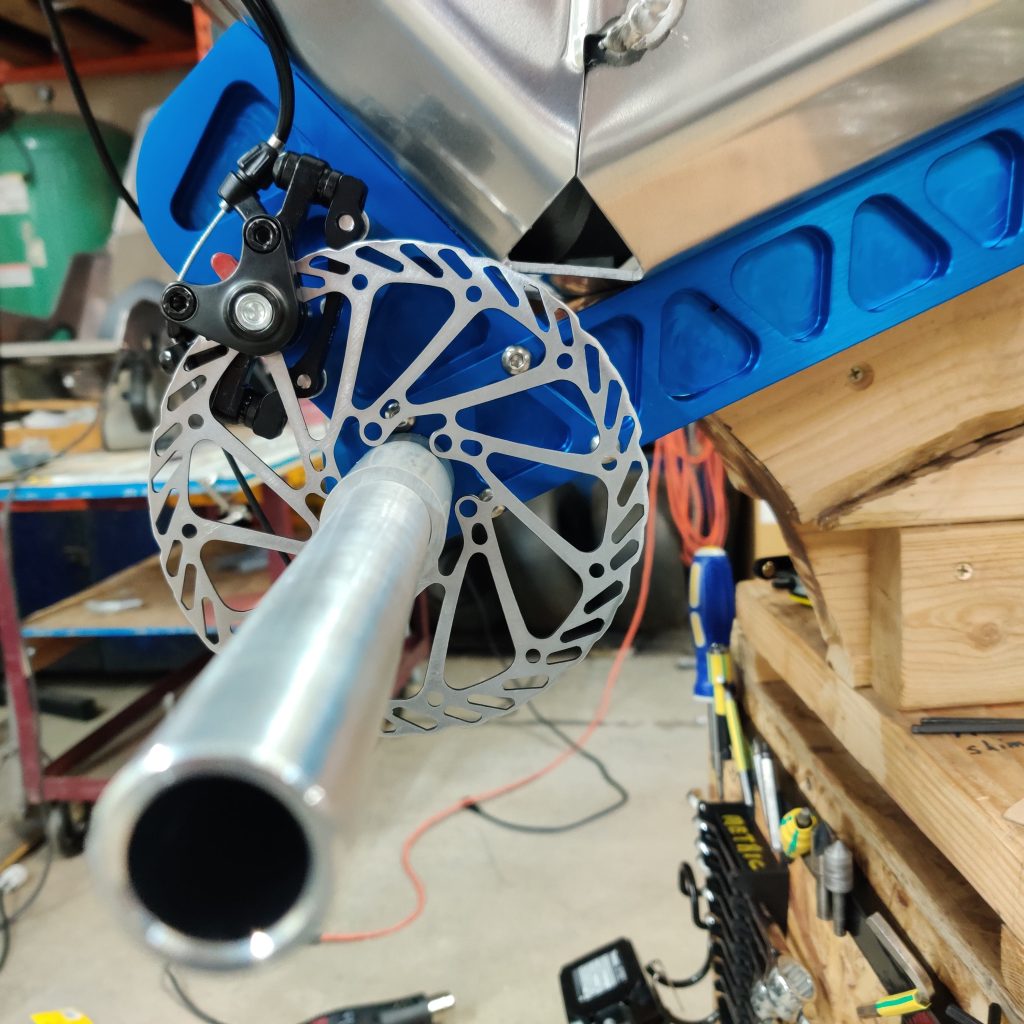
Every Extreme Motus comes standard with hydraulic disc brakes — reliable, easy to control, effective in wet and dusty conditions. A quality hydraulic brake system (calipers, lines, fluid, levers) costs $400–700. Standard rim brakes are cheaper ($100–200) but perform poorly on large wheels with sand in the bearings.
If you’re building DIY, don’t skimp on brakes. You’ll be on terrain where reliable stopping matters.
Assembly and Quality Control
Assembly takes time and precision. At our workshop in Springville, Utah, our mechanics mount components in a specialized jig to ensure every bracket, bolt, and wheel is square and tight. This takes 8–12 hours per chair. If you’re building DIY, budget that time yourself — or find a friend with patience.
The Real Cost: DIY vs. Buying
Let’s add it up honestly:
| Component | DIY Cost Range |
| Aluminum stock | $300–500 |
| Fasteners & welding materials | $300–600 |
| CNC time (or hand-drilling labor) | $500–2,000 |
| Seat (aluminum racing) | $300–800 |
| Wheels & tires (Wheeleez) | $1,800–2,400 |
| Braking system | $400–700 |
| Finish (powder coat/anodize) | $200–400 |
| Subtotal Materials | $3,800–7,400 |
| Your labor (100+ hours @ $20–50/hr) | $2,000–5,000 |
| Total DIY | $5,800–12,400 |
| Extreme Motus (assembled, tested, warranted) | $4,500 |
The verdict: A cheap DIY build still costs $5,800. A professional-quality DIY build often exceeds the Motus price. And at $4,500, you’re getting a chair that’s been engineered, tested, and backed by a warranty. If anything fails, we fix it. If your DIY welds fail at mile 50, you’re on your own.
When DIY Makes Sense
If you have a machine shop, 200+ hours of free time, and you’re building for learning rather than daily use, sure — DIY is a fun project. We’ve seen some beautiful custom builds on forums and Instructables. But for most people asking this question, the honest answer is: buy a chair that works rather than spend 2 years and $6,000+ building one that’s a gamble.
Ready-Made: The Smarter Choice
At Extreme Motus, we’ve perfected the design so you can skip the build and go straight to exploring. Our all-terrain wheelchairs are designed, assembled, and tested by skilled experts, ensuring you get the best in quality and performance without the headache.
All you have to do is pick your size and color, and we’ll ship it fully assembled and ready to roll.
👉 Order Your Extreme Motus All Terrain Wheelchair Now
Frequently Asked Questions
Can I really build an all-terrain wheelchair in my garage?
Technically yes, but you need a well-equipped shop: a band saw or mill for cutting aluminum, a TIG welder or brazing torch, and either a CNC mill or patience for hand-drilling. Most hobbyists lack at least one of these. If you have a machine shop available, it’s possible — but expect 100+ hours of work and $5,000+ in costs.
What’s the hardest part of building an all-terrain wheelchair DIY?
Either the CNC/machining (if you don’t have access) or the frame design itself. Most DIY builders under-engineer the seat mounting and bracing points, leading to flex or wobble. A professional designer spends 40+ hours refining these details; most DIY designs skip this step.
Can I adapt a standard wheelchair frame for all-terrain?
Not really. Standard wheelchair frames are designed for smooth surfaces and light lateral loads. All-terrain frames need wider mounting points for bigger wheels, stronger bracing for shock loads, and different seat geometry. You’d end up rebuilding so much that starting from scratch is simpler.
What about 3D printing or carbon fiber for DIY?
3D printing works for prototyping but not production frames — the material isn’t strong enough for repeated loads. Carbon fiber is light and strong but requires a vacuum bag setup, proper resin, and curing oven access. Both are more expensive and complex than aluminum welding for a one-off build.
Where can I find DIY plans?
Instructables has a few all-terrain wheelchair builds, and various forums (wheelchair-accessible outdoor adventure groups) share design sketches. Take them as inspiration only — none are engineered for safety like a production chair. If you do use plans, have them reviewed by a mechanical engineer before you build.
Does Extreme Motus offer custom builds or parts?
We offer sizing customization (seat width, cushion options, color choices) and can discuss minor modifications. Full custom frames are outside our scope — we sell tested, certified designs. But if you want something slightly different from stock, reach out and we’ll talk.
Try the Motus before you buy
Ride a Motus on real terrain near you. Feel the weight, test the suspension, see how it loads in your vehicle — all before you commit.
Free demo experience. No pressure. Locations across the U.S.
Request a demo experience →Ryan Grassley · ryan@extrememotus.com

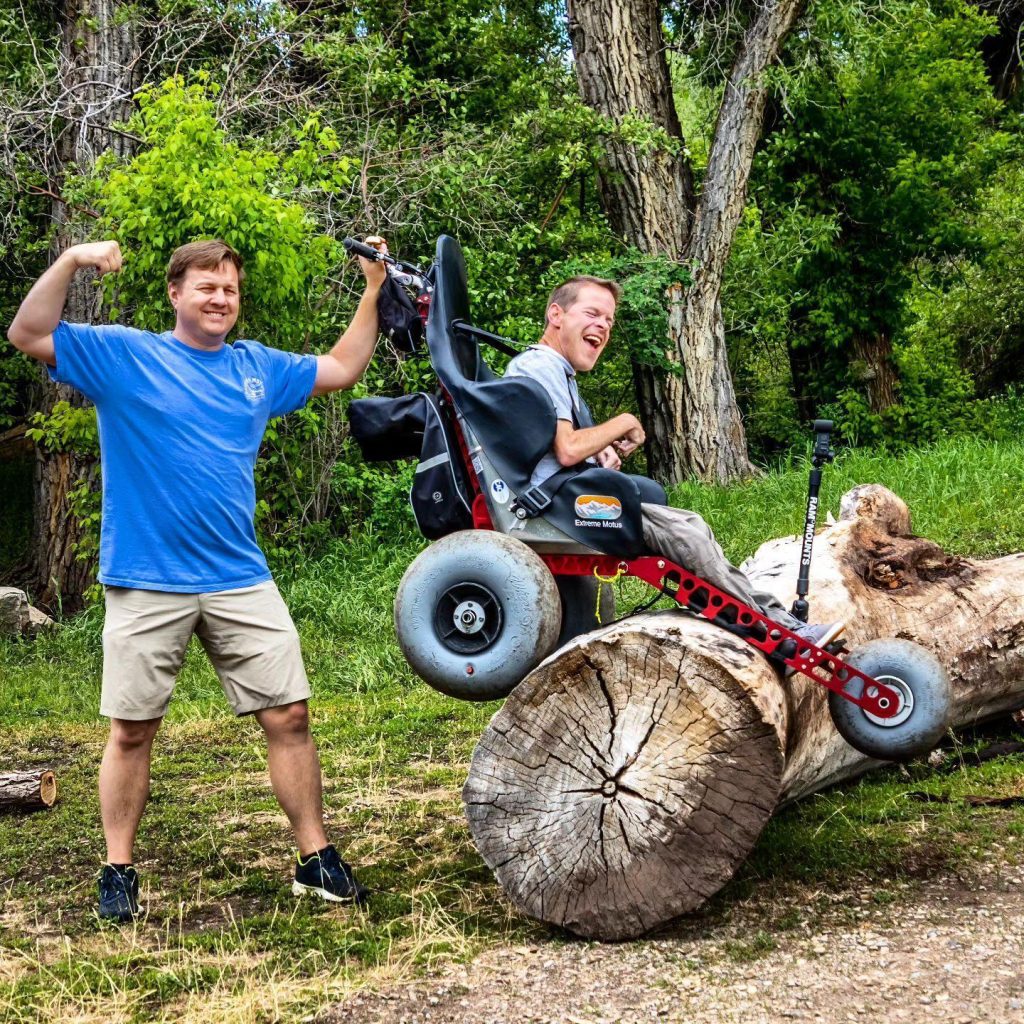
How it all started - Meet Sam & Ryan
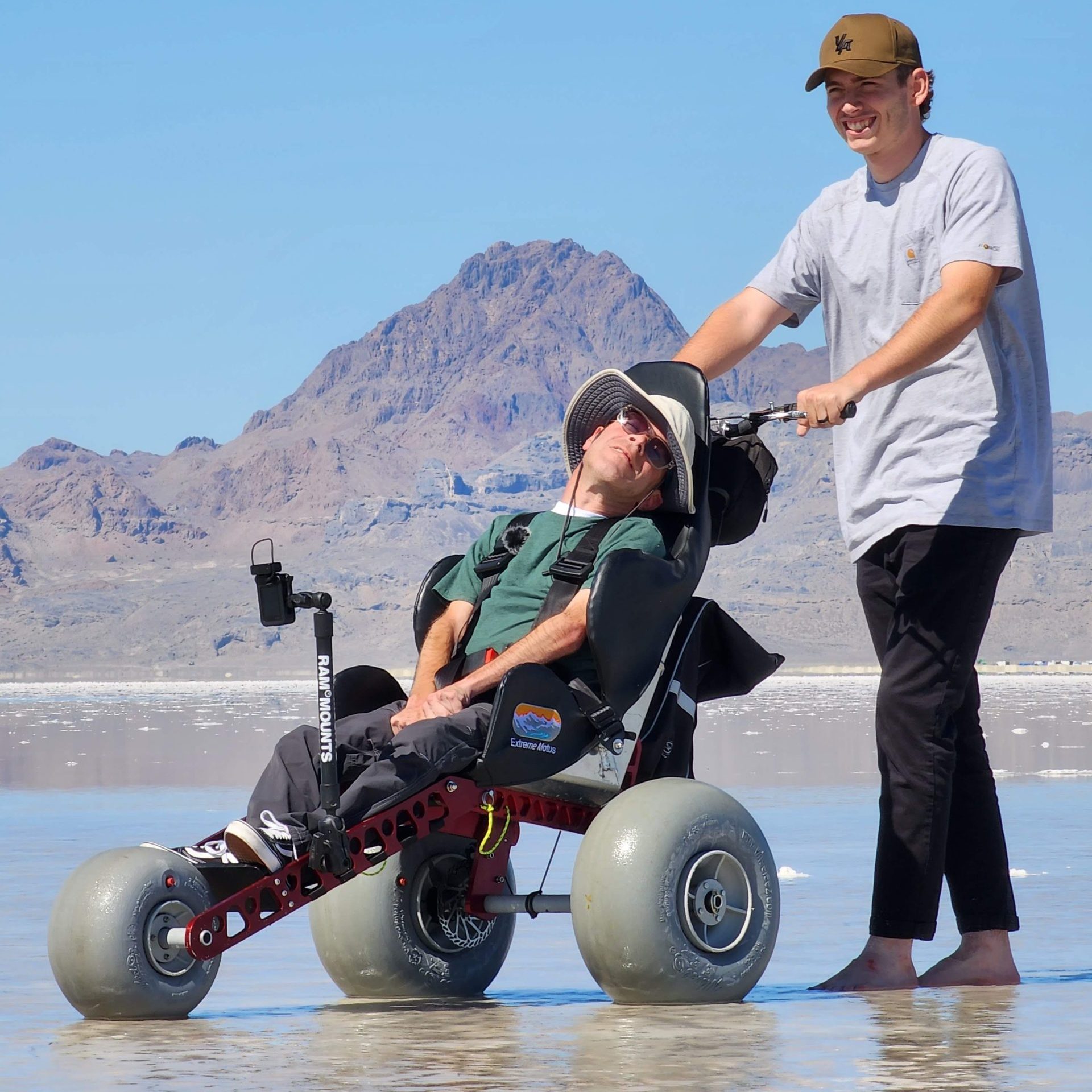
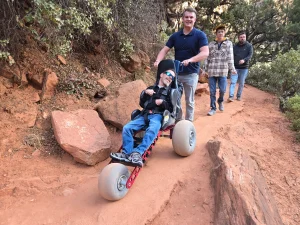
Since 2019, Sam and Ryan have been demonstrating that nature is wheelchair accessible with the Extreme Motus All Terrain Wheelchair. From National Parks to Skateparks, their adventures prove that a manual off-road wheelchair can offer laughter and joy while navigating diverse terrains.
Join us as we continue to share these inspiring journeys.
Discover Freedom with the Extreme Motus All Terrain Wheelchair
Light, comfortable, and compact, the Extreme Motus glides over sand, rocks, grass, gravel, and even floats in water.
It's more than a outdoor wheelchair; it's your ticket to freedom. Embrace the outdoors with confidence, knowing our off-road wheelchair is engineered for durability and ease of use.
Be the first to hear about new gear, upcoming adventures, and exclusive offers. As a welcome gift, you'll get a $100 coupon toward the Motus All-Terrain Wheelchair — delivered straight to your inbox.
By subscribing you agree to receive marketing communications from Extreme Motus, including product updates, promotions, and special offers. I understand I can unsubscribe at any time.