

Quick answer: A 3-wheeled all-terrain wheelchair like the Extreme Motus (55 lbs, $4,500) trades the stability of 4 wheels for a lighter frame and tighter turning radius. The wide stance and low center of gravity still provide excellent stability on sand, mud, and gravel while being easier to transport than heavier 4-wheel models. If weight and maneuverability matter more than maximum stability, 3-wheel is the move.

Find your grant in 90 seconds
Answer 5–7 quick questions and we’ll narrow 50+ adaptive-equipment grants down to the ones you’re most likely to win.
Free. No email required. Plus a 30-min strategy call with Kenny if you want help applying.
Take the Grant Match Quiz →You may have seen a manual 3-wheeled all-terrain wheelchair on social media and wondered, “What is that off-road wheelchair? Why only 3 wheels? Can it tip?” Good questions. Let me explain why we went with 3 wheels for the Extreme Motus, and why it works better than you might think.
What is the Extreme Motus All-Terrain Wheelchair?
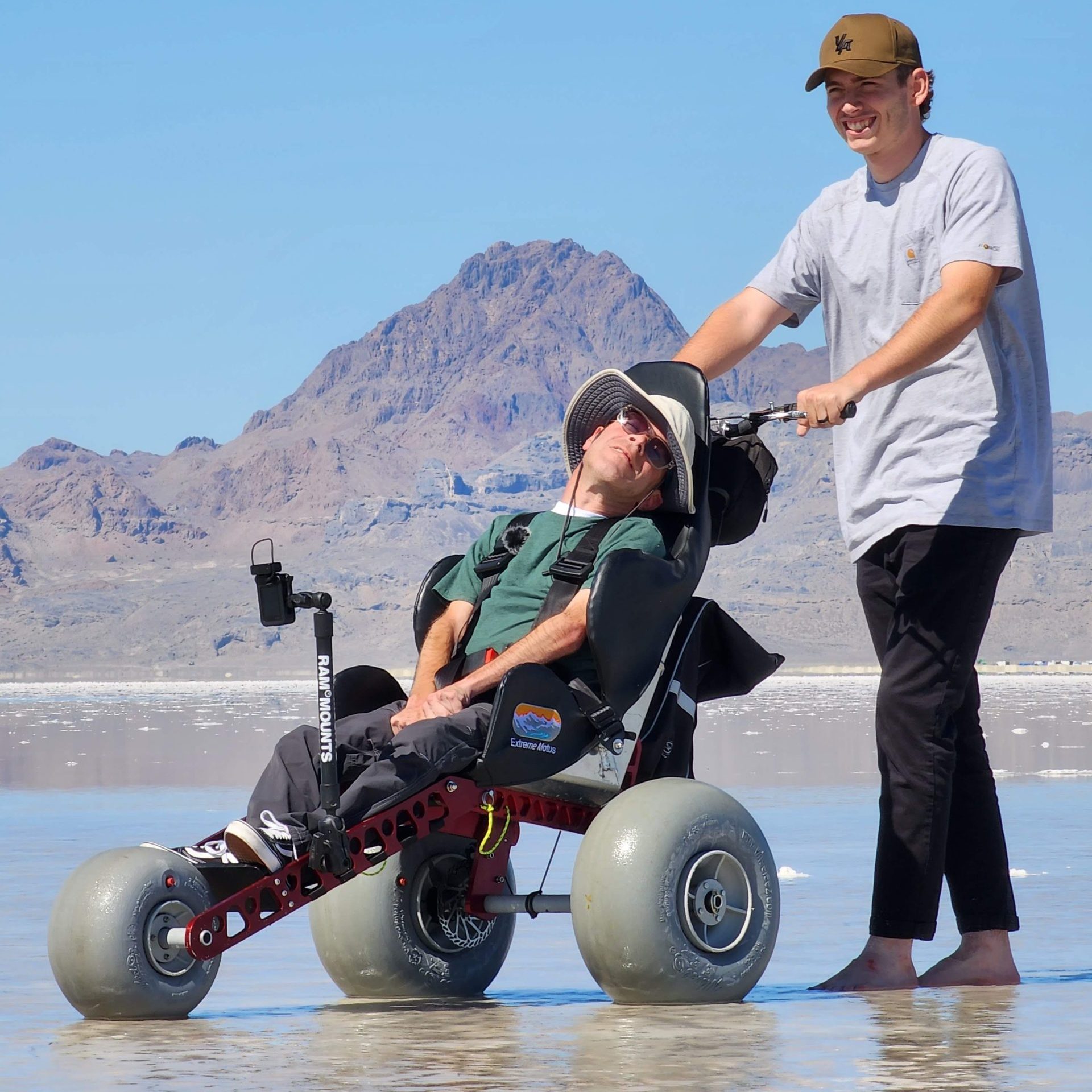
The Extreme Motus 3-wheeled all-terrain wheelchair is a specially designed wheelchair that allows people with mobility challenges to explore outdoor environments that are typically inaccessible to standard wheelchairs. Here are the core specs:
Key Features
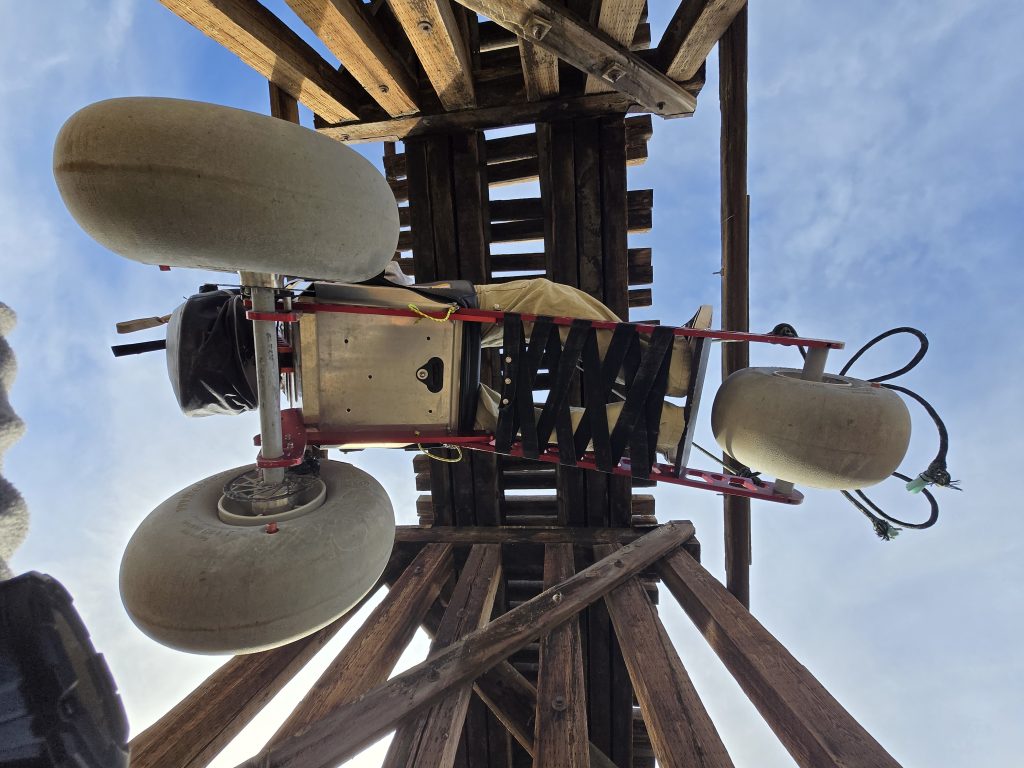
- 3-Wheel Design: One front wheel, two rear wheels. Lighter and more maneuverable than 4-wheel chairs while maintaining stability through a wide wheelbase.
- Lightweight Frame: Aluminum construction weighs just 55 pounds — one of the lightest all-terrain wheelchairs on the market, making it easy to transport and maneuver.
- Large Balloon Tires: The Wheeleez balloon tires run at 2–4 PSI and act as suspension, providing a smooth ride over sand, rocks, grass, gravel, snow, and even water.
- Wide Wheelbase & Stability: Despite having only 3 wheels, the long wheelbase and wide rear track offer excellent stability on uneven terrain. The chair doesn’t tip side-to-side because of the geometry.
- Folding Front Wheel: The front wheel assembly folds into the seat, making the chair compact for storage and car transport. Folded size is about 12″ deep — most sedan trunks have room.
- Buoyant Design: The tires are filled with enough air to make the chair float in water, allowing users to enjoy aquatic activities and wade through shallow crossings.
- Hydraulic Disc Brakes: Standard-issue braking system that works reliably in sand, mud, and wet conditions.
Why 3 Wheels Instead of 4?
This is the most common question. Here’s the engineering:
- Weight Savings: One fewer wheel = one fewer axle, one fewer tire assembly, less frame bracing. That’s roughly 10–15 lbs saved, which matters when a caregiver is pushing or a rider is self-propelling.
- Maneuverability: 3-wheel designs turn sharper and tighter. In narrow trails, sand dunes, or tight spaces, this is a real advantage. A 4-wheel chair has a longer turning radius.
- Stability: People assume 4 wheels = more stable. That’s true on a table, but not on uneven terrain. On soft sand or rocky ground, 4 wheels means each wheel can sink independently, creating flex and wobble. The Motus’s 3-wheel geometry — wide rear track, centered front wheel — creates a triangle of support. That triangle is inherently stable.
- Traction: Fewer wheels means more weight per wheel (same total weight, distributed across 3 instead of 4). More weight per wheel = more tire-to-ground pressure = better grip in sand and mud.
3-Wheel vs. 4-Wheel All-Terrain Wheelchairs
For context, here are some other 3-wheel and 4-wheel all-terrain options:
- 3-Wheel designs: Extreme Motus (55 lbs, $4,500), Vipamat Hippocampe (70 lbs, ~$3,500 EUR), Trekinetic K2 (all-terrain with 3-wheel drive option).
- 4-Wheel designs: GRIT Freedom Chair (50–60 lbs, $2,995–5,495), various tracked vehicles like Action Trackchair ($18,000+).
- Single-wheel hybrid: Some companies make single-large-wheel chairs like the Joëlette (pushed from behind) or Black Diamond TrailRider (backcountry, no user propulsion). These are ultra-light but require a strong, committed pusher.
The choice between 3 and 4 wheels comes down to your priorities: If you care most about weight and portability, 3-wheel wins. If you want maximum stability margin, 4-wheel is slightly more forgiving. For most outdoor families with one pusher, 3-wheel is the better answer.
Benefits of the Extreme Motus Design
- Accessibility: It opens up outdoor adventures, from national parks to beaches, making nature accessible to everyone, regardless of terrain.
- Comfort: The balloon tire design ensures a smooth ride, reducing the impact of bumps and uneven surfaces on the rider.
- Inclusivity: It allows people with mobility challenges to participate in outdoor activities with family and friends. The rider isn’t watching from the sidelines.
- Transportability: At 55 lbs and foldable to sedan-trunk size, you can actually take it places. A heavy 4-wheel or powered chair sits in a garage because loading it is too much work.
Who are Sam & Ryan?
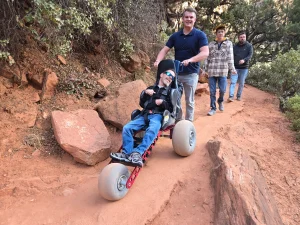
Sam and Ryan are the dynamic duo behind Extreme Motus. They’ve been friends since childhood. Sam has cerebral palsy, which makes it difficult to navigate rough terrains with a standard wheelchair. Ryan, always looking for ways to include his friend in outdoor activities, discovered the all-terrain wheelchair concept and knew it would be perfect for Sam. Together, they’ve been showcasing the Motus’s capabilities through adventures in national parks, skateparks, sand dunes, and other outdoor locations.
Their mission is to empower people with disabilities to enjoy the great outdoors and to demonstrate that with the right equipment, everyone can experience the beauty of nature.
You can follow their adventures on social media:
Where We’ve Been with the Motus
Sam and Ryan have taken the Extreme Motus 3-wheeled all-terrain wheelchair on some incredible adventures. Here are real locations they’ve explored:
- Arches National Park, Utah: They hiked all the way to Delicate Arch, one of Utah’s most treasured outdoor destinations.
- Coral Pink Sand Dunes, Utah: They’ve glided over the sandy dunes, showcasing the wheelchair’s ability to handle loose sand. This is also where the Motus doubles as a great beach wheelchair.
- Little Sahara Sand Dunes, Utah: They’ve tackled the sandy slopes, demonstrating the wheelchair’s versatility in challenging terrain.
- Timpanogos Trail, Utah: They’ve conquered rocky trails and enjoyed beautiful mountain scenery.
- Aspen Grove Trailhead, Utah: They’ve hiked up to Lower Falls, navigating rocky and uphill terrain.
- Snowy Slopes: They’ve even taken the wheelchair out in the snow, proving it can handle winter conditions with ease.
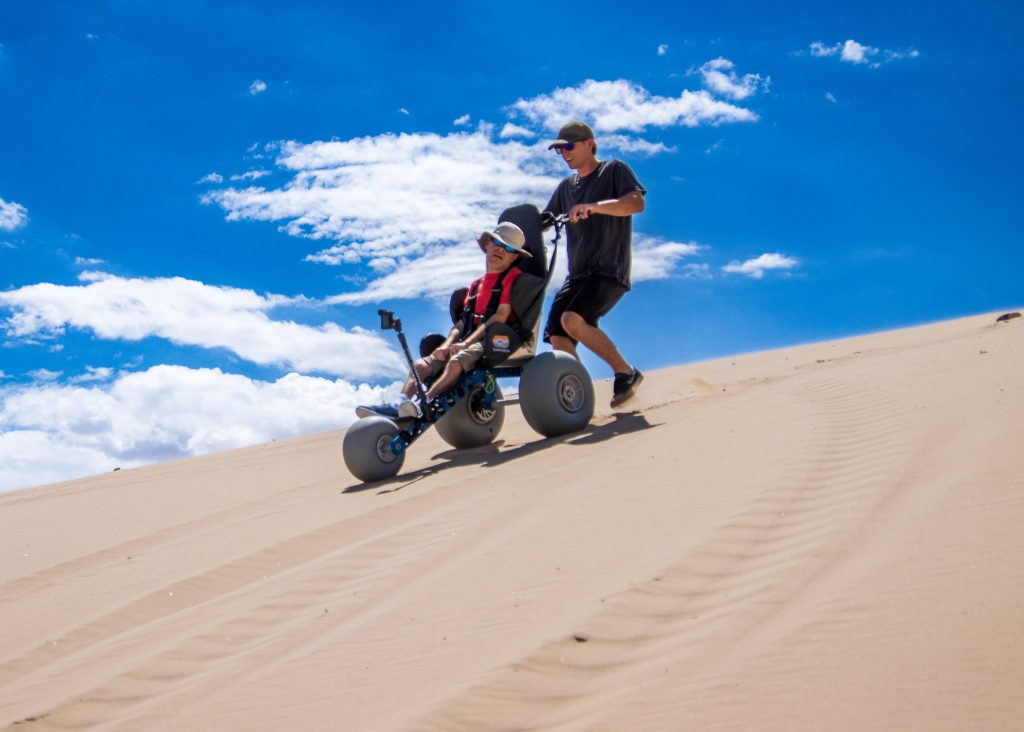
These adventures highlight the all-terrain wheelchair’s capability to provide access to a variety of terrains, making outdoor exploration possible for everyone.
Ready to Order?
If you’re ready to order your very own 3-wheeled Extreme Motus all-terrain wheelchair, head to our online store, or give Ryan a call. He’ll be happy to answer any questions about the Motus and help you find the right size and setup.
Frequently Asked Questions
Why does the Motus have only 3 wheels? Won’t it tip?
Good question. The 3-wheel design creates a stable triangle of support — two large rear wheels and one front wheel. The wide wheelbase prevents side-to-side tipping. In fact, 3 wheels are actually more stable on soft terrain (sand, mud) than 4 wheels, because the weight is distributed across fewer contact points, increasing grip. Plus, the chair is lighter (55 lbs vs. 60+ lbs for 4-wheel designs), making it easier to control and transport.
How does the Motus compare to a 4-wheel all-terrain chair like the GRIT Freedom Chair?
Both are excellent. The Motus is lighter (49 vs. 50–60 lbs), folds more compactly, and is more maneuverable. The GRIT Freedom Chair is self-propelled and better for riders with strong upper bodies who don’t have a dedicated pusher. The Motus is designed for caregiver-pushed or self-propelled, and costs $4,500 vs. the GRIT’s $2,995–5,495. Pick based on your use case.
Can the Motus actually float?
Yes. The Wheeleez balloon tires are buoyant enough to keep the chair and rider afloat in water. Sam and Ryan have done videos wading through streams and even floating on lakes. The rider needs a personal flotation device for safety, but the chair itself provides buoyancy.
What’s the weight capacity of the Motus?
300 pounds. The frame and tires are engineered to handle that load safely. If you’re over 300 lbs, we can discuss custom options, but stock is rated for up to 300 lbs.
How much does the Motus cost?
$4,500 for the standard chair, fully assembled and ready to ship. We offer financing options (6–24 months) if needed. The price includes the aluminum frame, Wheeleez tires, hydraulic disc brakes, aluminum racing seat, and a 1-year warranty covering manufacturing defects.
Does it fit in a car?
Yes. Folded, the Motus is about 12″ deep and weighs 55 lbs. Most sedan trunks have room. A single person can lift it in and out. SUVs and minivans give you even more room and flexibility.
Ryan Grassley · ryan@extrememotus.com
Try the Motus before you buy
Ride a Motus on real terrain near you. Feel the weight, test the suspension, see how it loads in your vehicle — all before you commit.
Free demo experience. No pressure. Locations across the U.S.
Request a demo experience →
How it all started - Meet Sam & Ryan
Since 2019, Sam and Ryan have been demonstrating that nature is wheelchair accessible with the Extreme Motus All Terrain Wheelchair. From National Parks to Skateparks, their adventures prove that a manual off-road wheelchair can offer laughter and joy while navigating diverse terrains.
Join us as we continue to share these inspiring journeys.
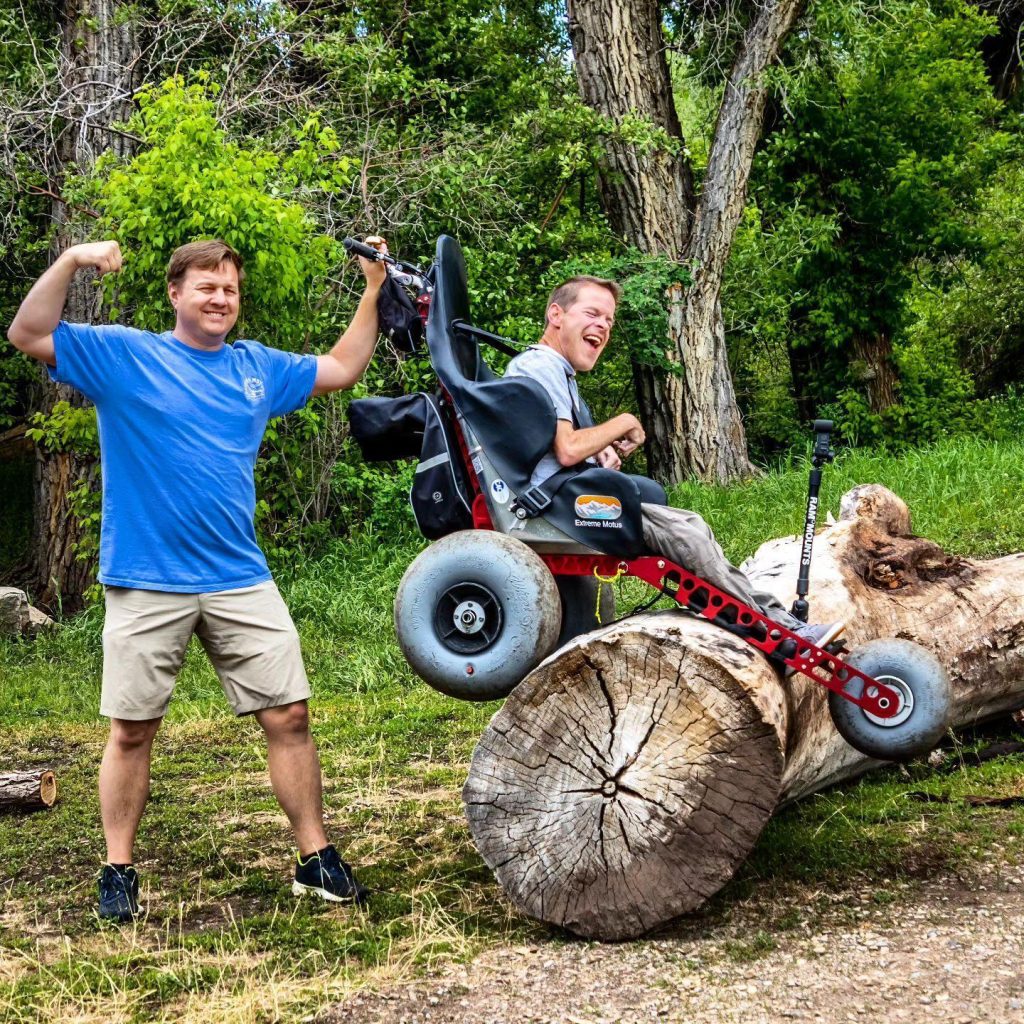
Discover Freedom with the Extreme Motus All Terrain Wheelchair
Light, comfortable, and compact, the Extreme Motus glides over sand, rocks, grass, gravel, and even floats in water.
It's more than a outdoor wheelchair; it's your ticket to freedom. Embrace the outdoors with confidence, knowing our off-road wheelchair is engineered for durability and ease of use.
Be the first to hear about new gear, upcoming adventures, and exclusive offers. As a welcome gift, you'll get a $100 coupon toward the Motus All-Terrain Wheelchair — delivered straight to your inbox.
By subscribing you agree to receive marketing communications from Extreme Motus, including product updates, promotions, and special offers. I understand I can unsubscribe at any time.