

What is Osteogenesis Imperfecta (Brittle Bone Disease)?
Quick answer: Osteogenesis Imperfecta (OI), or brittle bone disease, is a genetic disorder caused by mutations in the COL1A1 or COL1A2 genes — the genes responsible for producing collagen. It affects roughly 1 in 10,000 to 20,000 people, with severity ranging from a mild form that barely limits daily life to a perinatal-lethal form. There’s no cure, but treatment focused on bone strengthening and fracture prevention can make a real difference.
Most people know it by its plain-language name: brittle bone disease. When collagen — the protein that gives bone its structural strength — doesn’t form correctly, bones fracture far more easily than they should, sometimes from nothing more than an awkward step or a hug. Understanding what causes it, how it’s treated, and why outdoor time matters can make a real difference for individuals and the families supporting them.
1. What Causes Osteogenesis Imperfecta?
It’s a common assumption that brittle bones mean a calcium or nutrition issue. They don’t. OI comes from mutations in the COL1A1 or COL1A2 genes, which are responsible for producing collagen. Defective collagen means bone tissue never gets built to full strength in the first place, which is why fractures happen from forces that wouldn’t touch a typical bone.
2. How Many People Are Affected by OI?
OI shows up in an estimated 1 in 10,000 to 20,000 people worldwide, which works out to somewhere between 25,000 and 50,000 people living with it in the U.S. alone. It doesn’t skew by gender or ethnicity — anyone can have it.
3. What Are the Different Types of OI?
Doctors use the Sillence classification to sort OI into eight types. Type I is the mildest — mild bone fragility, blue-tinted sclerae (the whites of the eyes), close-to-normal height, and hearing loss that tends to show up in adulthood. Type II is perinatal-lethal: severe deformity that’s usually fatal shortly after birth due to respiratory complications. Types III and IV sit in the moderate-to-severe range, with progressive deformity and mobility that varies a lot person to person, usually requiring ongoing orthopedic care. Types V through VIII are rarer variants, each with its own distinct features and inheritance pattern. Most cases follow an autosomal dominant pattern — a single mutated gene copy from one parent is enough to bring a 50% risk to each child.
4. What Are the Treatments for OI?
Nothing reverses OI, but the treatment toolkit is more substantial than people expect. Bisphosphonate drugs like pamidronate and zoledronic acid increase bone density and cut fracture rates. Physical therapy builds the muscle that helps protect fragile bones. Orthopedic surgery — intramedullary rodding, most commonly — reinforces bones from the inside and corrects deformity. Pain management addresses the chronic pain that comes with fractures and skeletal changes. And gene therapy and stem cell research, while not yet standard treatment, are active areas of investigation that could change the picture in years to come.
5. How Does OI Affect Families?
Living with OI means frequent hospital visits, ongoing fracture treatment, and therapy that doesn’t really stop. Someone in the family is usually providing near-constant supervision. Medical costs, adaptive equipment, and home modifications add up fast, and financial strain becomes its own chronic stressor. Even routine outings require planning most families never have to think about, just to keep injury risk low. None of that shows up on an X-ray, but it’s as real as the diagnosis itself.
6. Why Can OI Require a Wheelchair?
For people with moderate to severe OI, a wheelchair isn’t a last resort — it’s often the tool that keeps them mobile and safe at the same time. Recurrent fractures limit how much walking is realistic. Spinal deformity can make ambulation both difficult and risky. Chronic pain in the joints and bones lowers tolerance for standing or walking, and supporting fragile bones without a wheelchair takes a level of muscular effort that isn’t sustainable for everyone. Used right, a wheelchair protects vulnerable bones from further injury while giving someone back their independence — not one at the expense of the other.
7. Why Is Spending Time Outdoors Important for OI?
Nature does the usual things for mental health — cutting stress and anxiety, building emotional resilience — but for someone managing OI, it does more than that. Sunlight supports vitamin D production, which matters directly for bone health. Low-impact outdoor movement improves circulation without adding fracture risk. And outdoor spaces create the kind of family bonding and community connection that’s easy to lose when every outing has to be carefully managed. For someone living inside real physical limits, time outside is less “nice to have” and more a genuine outlet.
8. How Can an All-Terrain Wheelchair Empower People with OI?
An all-terrain wheelchair isn’t the same tool as a standard indoor chair, and for OI specifically, the difference matters. Shock-absorbing suspension cuts the vibration and impact that a standard chair transmits straight into fragile bones. Proper ergonomic seating takes strain off the spine and joints. A frame built for sand, gravel, grass, and rough trail means terrain stops being the limiting factor. And beyond the physical mechanics, it means less day-to-day reliance on a caregiver, a seat at family outings that would otherwise be impossible, and — maybe most importantly — room to build real confidence instead of just managing risk.
Frequently Asked Questions
Is Osteogenesis Imperfecta hereditary?
Usually, yes. Most cases follow an autosomal dominant pattern, where a single mutated gene copy from one parent brings a 50% risk to each child. About 10% to 15% of cases come from a new mutation with no family history at all.
Can OI be cured?
Not currently. Treatment focuses on strengthening bone, preventing fractures, and managing symptoms rather than reversing the underlying collagen defect. Gene therapy and stem cell research are active areas of investigation, but neither is standard treatment yet.
What is the life expectancy for someone with OI?
It depends heavily on type. Type I generally comes with a near-normal lifespan. Types III and IV can see reduced life expectancy tied to complications from the condition. Type II is often fatal in infancy. Across the board, modern medical care has meaningfully improved outcomes compared to even a generation ago.
How often do people with OI experience fractures?
It varies a lot by type and by individual. Someone with Type I might go long stretches with no fractures at all; someone with Type III or IV can experience multiple breaks in a single year. Bisphosphonate therapy has measurably lowered fracture rates across the board.
What support resources are available for families?
The Osteogenesis Imperfecta Foundation and the Brittle Bone Society are the two most established resources for education and advocacy. Genetic counseling, physical therapy, and peer support groups round out the practical side — and for a lot of families, connecting with someone who’s already living it does more good than any pamphlet.
Conclusion: Living Fully with Osteogenesis Imperfecta
OI presents real, physical limits — but between modern treatment and adaptive tools built for the job, “living with brittle bones” doesn’t have to mean living smaller. Bone protection, consistent care, and the right mobility equipment together open the door to the same outdoor experiences and family connection everyone else takes for granted.
Ryan Grassley · ryan@extrememotus.com
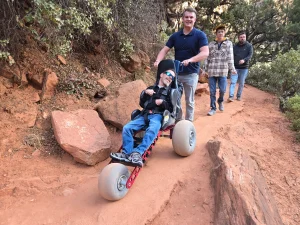
How it all started - Meet Sam & Ryan
Since 2019, Sam and Ryan have been demonstrating that nature is wheelchair accessible with the Extreme Motus All Terrain Wheelchair. From National Parks to Skateparks, their adventures prove that a manual off-road wheelchair can offer laughter and joy while navigating diverse terrains.
Join us as we continue to share these inspiring journeys.
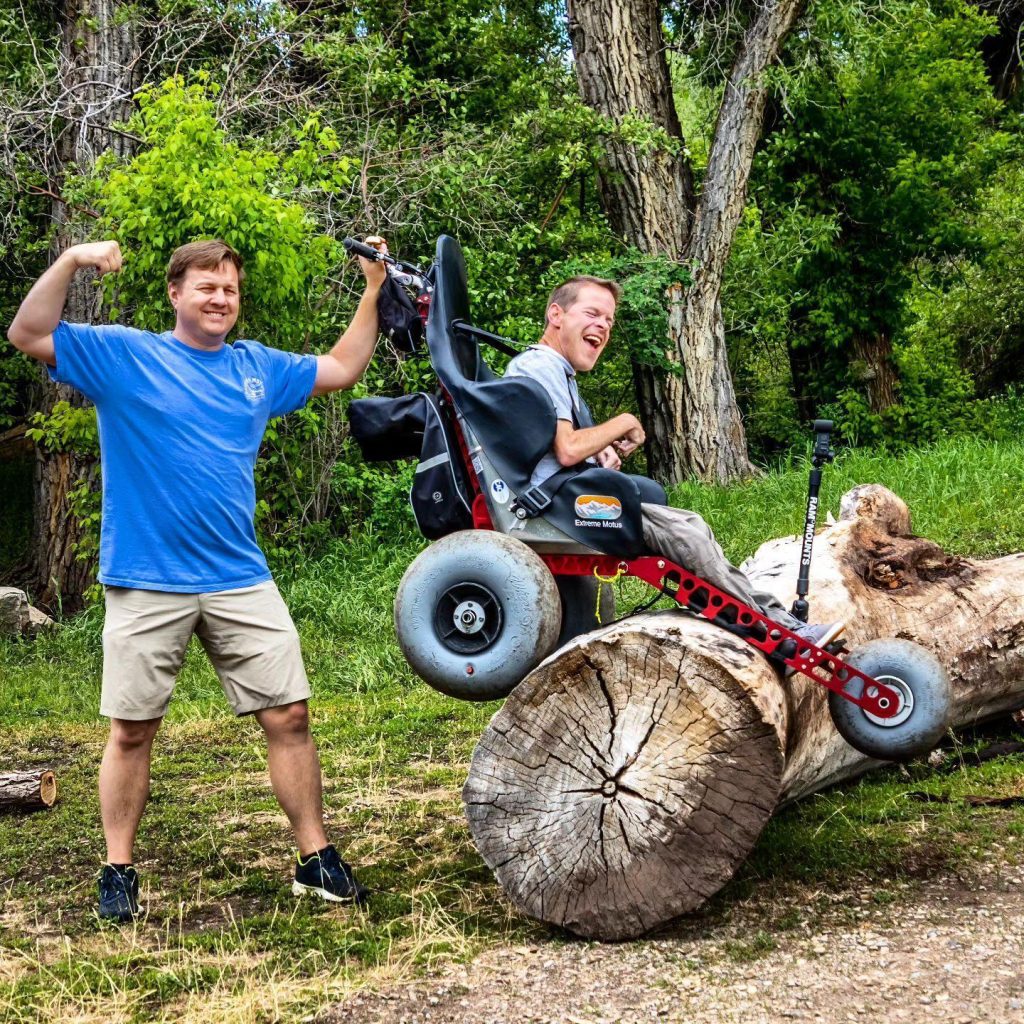
Discover Freedom with the Extreme Motus All Terrain Wheelchair
Light, comfortable, and compact, the Extreme Motus glides over sand, rocks, grass, gravel, and even floats in water.
It's more than a outdoor wheelchair; it's your ticket to freedom. Embrace the outdoors with confidence, knowing our off-road wheelchair is engineered for durability and ease of use.
Be the first to hear about new gear, upcoming adventures, and exclusive offers. As a welcome gift, you'll get a $100 coupon toward the Motus All-Terrain Wheelchair — delivered straight to your inbox.
By subscribing you agree to receive marketing communications from Extreme Motus, including product updates, promotions, and special offers. I understand I can unsubscribe at any time.