

Quick answer
The 6 most affordable manual all-terrain wheelchairs in 2026: 1. GRIT Freedom Chair ($2,995–$5,495) · 2. Hippocampe ($4,036–$5,800) · 3. Extreme Motus ($4,500) · 4. Trekinetic K2 ($7,040) · 5. Black Diamond TrailRider ($7,500–$8,200) · 6. AdvenChair ($11,950). Manual chairs weigh 33–63 lbs (vs. 400+ lbs for powered tracked chairs), fit a sedan trunk, and need no batteries. Use the quiz below to match one to your terrain, propulsion, and budget. Comparison table and a real “how do I afford this?” walkthrough are further down.
Find your grant in 90 seconds
Answer 5–7 quick questions and we’ll narrow 50+ adaptive-equipment grants down to the ones you’re most likely to win.
Free. No email required. Plus a 30-min strategy call with Kenny if you want help applying.
Take the Grant Match Quiz →Manual all-terrain wheelchairs offer real advantages over their powered counterparts: lighter, cheaper, easier to transport, and no batteries to charge. For most outdoor adventures with a willing caretaker or strong-armed rider, a manual chair is the right call.
Find your all-terrain wheelchair
Cheapest isn’t always best value. Take the 30-second Adventure Quiz above to see which of these 6 chairs actually fits the trails, beaches, or terrain you want to tackle. The right answer might not be the cheapest — but it’ll save you money on add-on kits and second chairs you’d buy later.
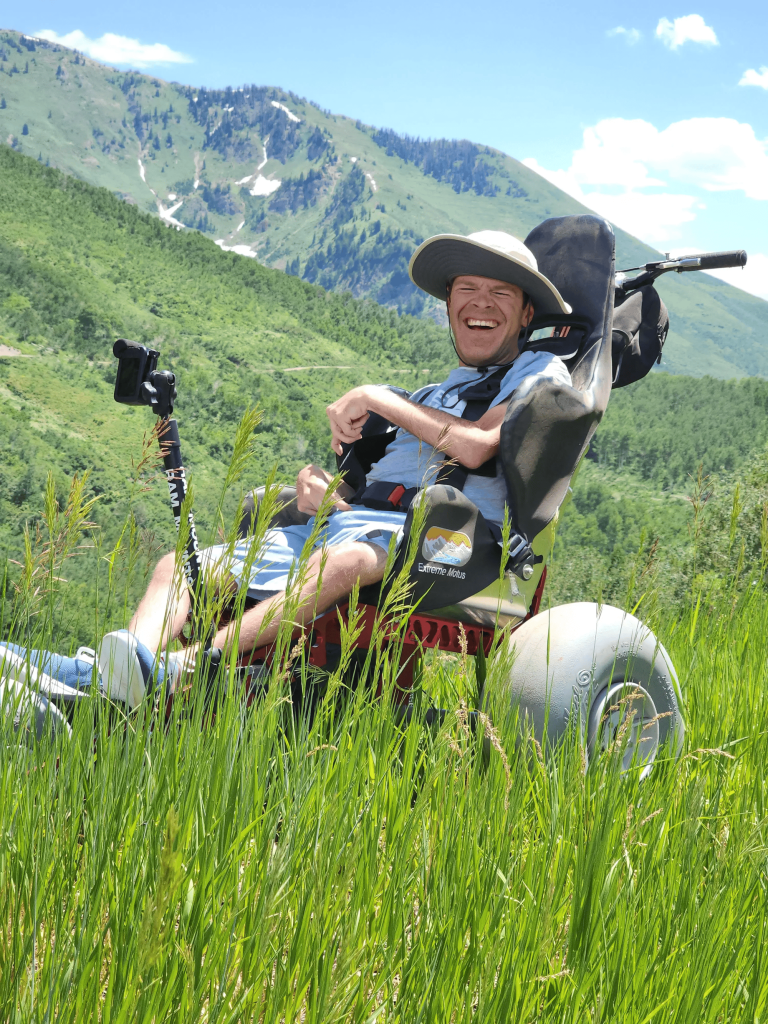
Why a manual all-terrain wheelchair?
- Lightweight: 33–75 lbs vs. 400–500 lbs for powered tracked chairs.
- Affordable: $3K–$12K vs. $13K–$28K+ for powered chairs.
- No batteries: No charging, no battery anxiety on long days.
- Easier transport: Most fold or break down for a sedan trunk.
- Physical activity: Self-propelled chairs build upper-body strength.
- Easier repair: Fewer electronics, more standard mountain-bike parts.
The 6 most affordable manual all-terrain wheelchairs
1. GRIT Freedom Chair — $2,995–$5,495
Weight: 45 lbs · Propulsion: Self-propelled (lever drive)
The GRIT Freedom Chair is the cheapest entry on this list. Designed by MIT engineers, the lever-drive system is roughly twice as efficient as pushing standard wheelchair rims — less shoulder strain over long distances. Three-wheel trike layout for stability, breaks down to a 25-lb heaviest piece for transport. Best for self-propelling riders with strong upper bodies on dirt and gravel; not built for water or deep sand.
Considering a GRIT vs. the Motus? Read the deep-dive comparison →
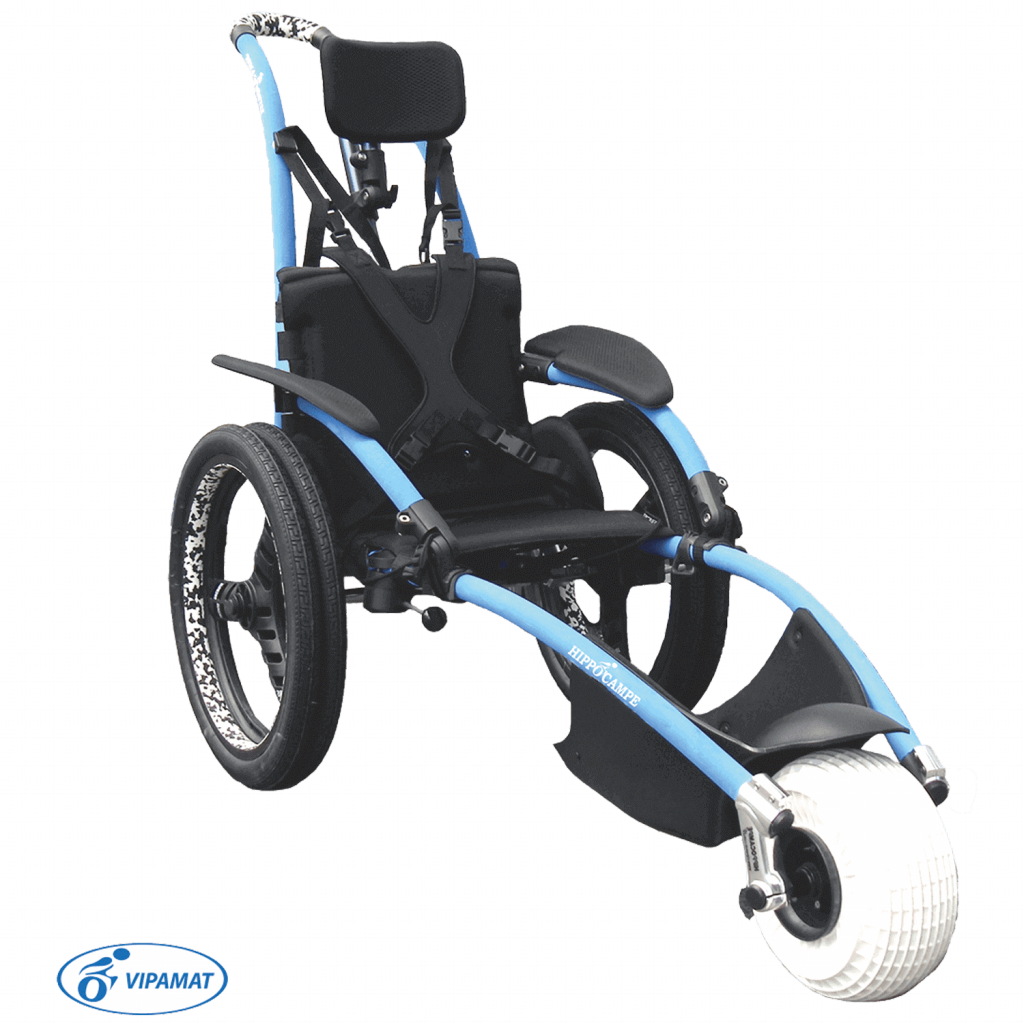
2. Hippocampe (Vipamat) — $4,036–$5,800
Weight: 37 lbs · Propulsion: Caretaker-pushed or self-propelled
The Hippocampe is a beach-focused chair that floats and handles soft sand. Stainless steel frame, foldable, four sizes (S/M/L/XL). Big caveat: no brakes, which makes it a poor pick for any hike with downhill sections. Great on flat beaches, awkward elsewhere.
3. Extreme Motus — $4,500
Weight: 55 lbs · Propulsion: Caretaker-pushed
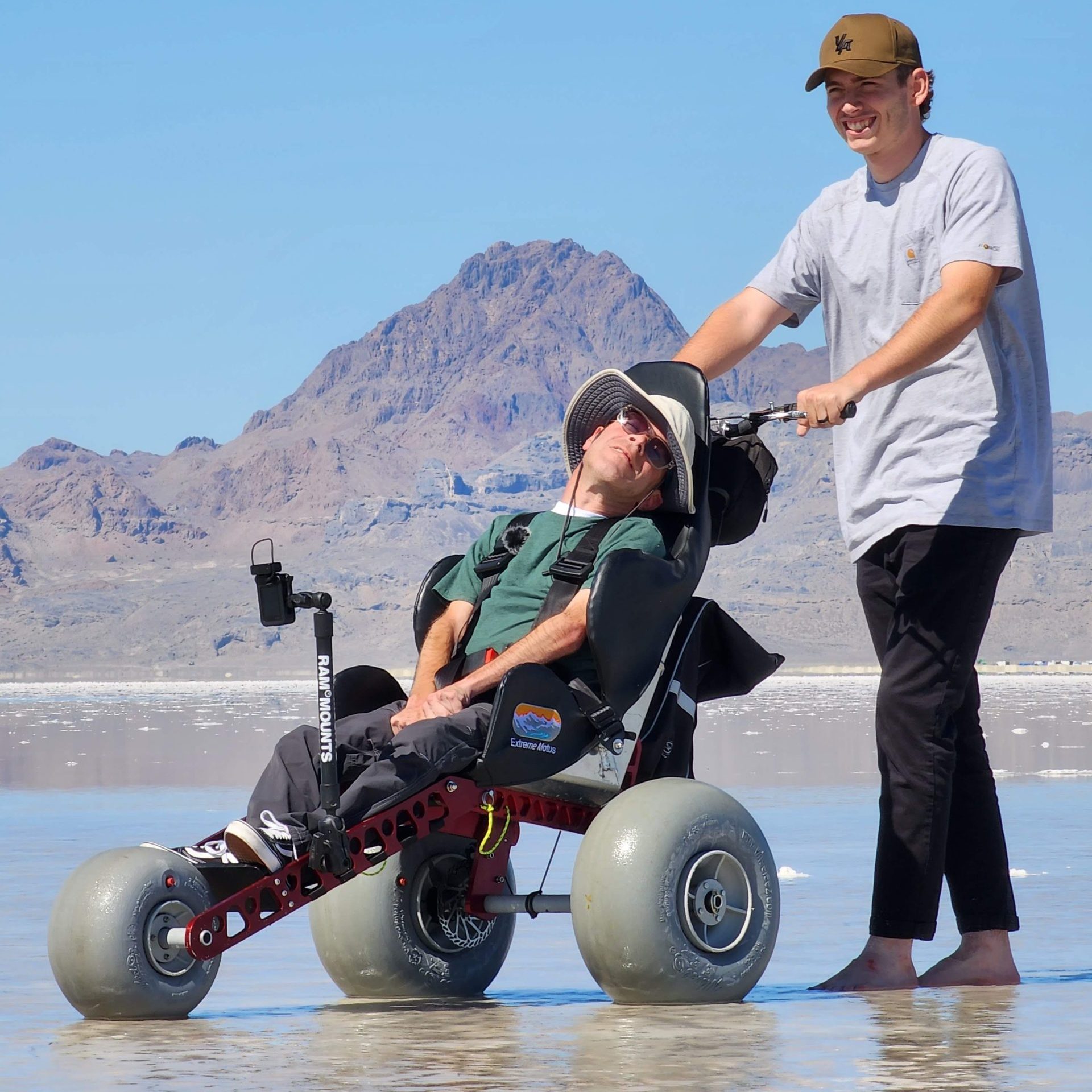
The Extreme Motus is the most versatile chair on this list. Three large low-pressure Wheeleez balloon tires roll over sand, snow, gravel, mud, dirt, and rocks. Floats in shallow water. Folds in half for sedan-trunk transport. Aluminum frame, hydraulic disc brakes, optional 5-point harness for riders with limited trunk control.
What sets it apart: no other manual chair at this price handles this many surface types. Same chair takes you from beach to mountain trail to snowy day at the park.
→ The “true cost” of cheaper chairs
The cheapest options on this list save you $1,000–$1,500 up front — but they’re typically single-environment chairs. The GRIT is a dirt/gravel chair (no float, struggles in deep sand). The Hippocampe is a beach chair (no brakes, awkward on trails). If you want one chair that handles beach, snow, dirt, and a downhill trail, the Motus comes that way standard. No second chair, no add-on kits.
Ready to look at the Motus? $4,500. Free shipping over $375. Ships in 2–3 weeks.
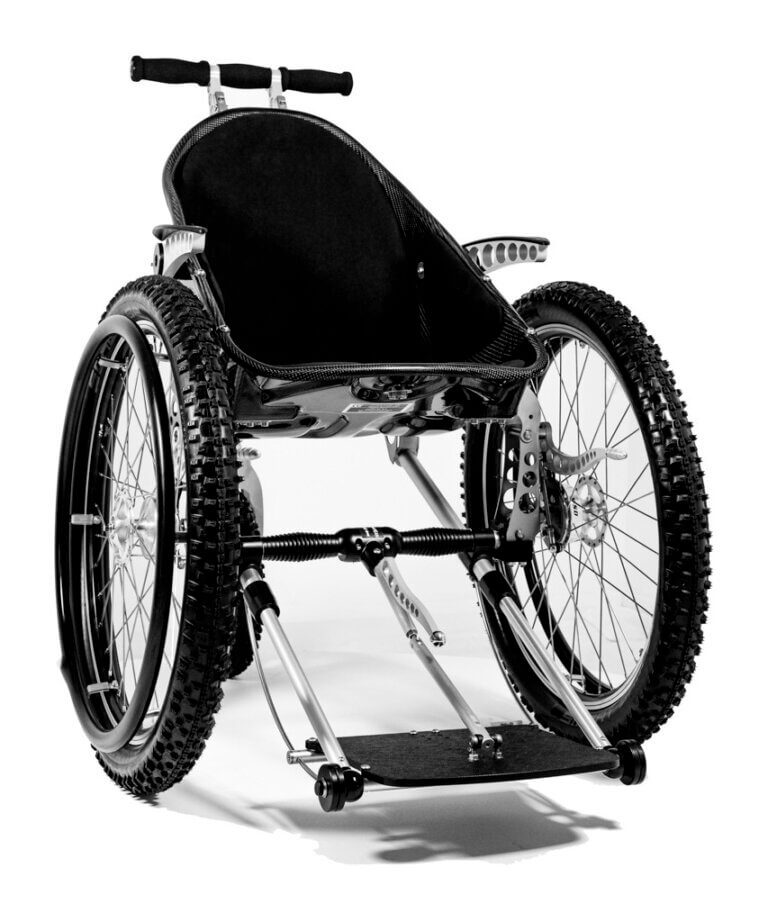
4. Trekinetic K2 — $7,040
Weight: 33 lbs · Propulsion: Self-propelled
The Trekinetic K2 is the lightest chair on this list and the most engineered. Carbon fiber frame, three-wheel-drive layout (two large fronts, one small rear), patented Varicam adjustable wheel angle, dynamic braking system you operate without touching the wheels. Folds into a small vehicle. Premium build for self-propelling riders who want maximum maneuverability across mixed terrain.
5. Black Diamond TrailRider — $7,500–$8,200
Weight: 50 lbs · Propulsion: Team-pushed (1–3 helpers)
The TrailRider is a single-wheel sherpa-style chair with rickshaw handles fore and aft. Built for big nature — adjustable handles let helpers lift the unit over logs and boulders without jolting the rider. Capacity: 240 lbs. Typically needs 1–3 assistants depending on terrain. Great for technical wilderness; overkill for everyday park use.
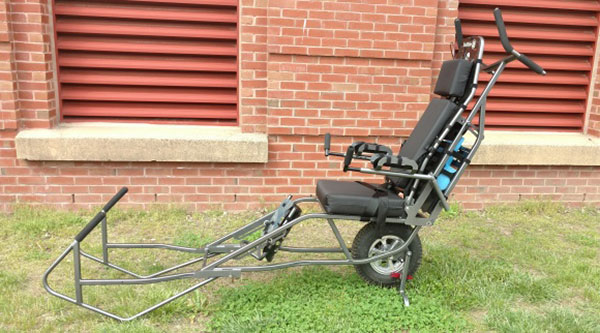
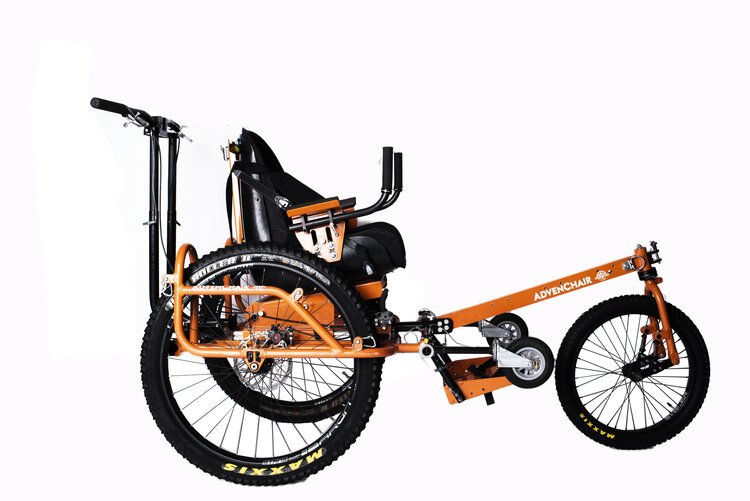
6. AdvenChair 3.2 — $11,950
Weight: 63 lbs · Propulsion: Caretaker- or team-pushed (1–5 helpers)
The AdvenChair is the most expensive — and the most engineered — option here. Built around premium mountain bike components (wheels, tires, brakes, handlebars), a Cushcore inner-tire suspension system for smooth rides, fully adjustable, converts between long-wheelbase All-Terrain Mode and a 31-inch indoor wheelchair. Lightweight 6061 T6 aluminum frame, 250 lb rider rating. Built for riders who want a transformer chair that handles serious technical terrain and still rolls indoors.
Price vs. value at a glance
Cheapest isn’t the same as best value. Here’s how the 6 stack up on what actually matters in the field:
| Chair | Base price | Sand & snow | Floats | Brakes | Solo push |
|---|---|---|---|---|---|
| GRIT Freedom Chair | $2,995 | Limited | No | Yes | Self-propelled |
| Hippocampe | $4,036+ | Sand only | Yes | No | Yes |
| Extreme Motus | $4,500 | Yes | Yes | Hydraulic disc | Yes |
| Trekinetic K2 | $7,040 | Limited | No | Dynamic | Self-propelled |
| Black Diamond TrailRider | $7,500 | Yes | No | Yes | Needs 1–3 |
| AdvenChair 3.2 | $11,950 | Yes | No | Premium | Yes |
The Motus is the only chair under $5,000 with sand & snow capability, flotation, hydraulic disc brakes, and solo-caretaker push — all standard, no add-on kits.
How to actually afford one
$4,500 is real money. Most customers don’t pay it out of pocket in one shot. Here are the real paths people use:
1. Grants & nonprofits
Many disability grants and adaptive-sports nonprofits cover all-terrain chairs. Our 11 Best Grants guide walks through the application paths and contacts.
2. Crowdfunding
GoFundMe campaigns work well for adaptive equipment. We’ve helped customers organize family and community fundraisers and contributed match funds to qualifying campaigns.
3. Financing
Spread the $4,500 over monthly payments instead of a lump sum. See current financing options →
4. Medicaid waivers
Some states allow Medicaid HCBS waivers to fund recreational mobility equipment. Read why Medicare won’t cover it and what to do instead.
Try one before you buy
→ See all 59 locations on our interactive map
If $4,500 still feels like a leap of faith, you can test-drive a Motus on real terrain first — at parks, zoos, adaptive sports nonprofits, and rental programs across the US, Canada, Australia, and the UK. Find a location near you on our map →
A few of the highlights:
- Bryce Canyon National Park — free trail loaner
- Alaska Zoo — $25 rental, 2.5 hours, walk-up
- Forest Preserve District of DuPage County — free reservation
Want to bring an Extreme Motus to your local park? Email ryan@extrememotus.com — we partner with parks, conservancies, and rec districts on loaner programs.
Is it worth $4,500? Real reviews from real riders.
Two of the most common questions about the Motus are “is it worth it?” and “will it sit in the garage?” These customers answered both:
★★★★★
“Caitlin thoroughly enjoyed the entire hike and loves it when family and friends help with the ropes we’ve attached for the steeper inclines. Her chair is also a lifesaver when trekking across the wide sandy beaches of the Florida Gulf Coast. We’re glad you all came up with this ‘hiking chair.’”
— Darren, Crater Lake & Florida Gulf Coast
★★★★★
“Every time our son gets to be included in an activity he previously wouldn’t have been is a new favorite. He has gone to a beach, hiking in the woods, an apple orchard, an arboretum, many trails, and most importantly our backyard — which was not suitable for his everyday wheelchair.”
— Courtney, Motus Family
More stories: Kevin & Jacque (Hawaii to Zion) · The Dursts · Henry Evans (brainstem stroke survivor)
How to choose between them
The big filter is who’s pushing:
- Self-propelling rider: GRIT Freedom Chair (cheapest), Trekinetic K2 (most engineered), Hippocampe (beach only)
- One caretaker pushing: Extreme Motus (most versatile), Hippocampe (beach only), AdvenChair (premium)
- Team of helpers: Black Diamond TrailRider (technical wilderness), AdvenChair (transformer)
Then it’s terrain (water/sand vs. trails vs. backcountry) and budget. Use the quiz at the top to narrow it down to your top 3 personalized matches.
Frequently asked questions
What’s the cheapest manual all-terrain wheelchair?
The base GRIT Freedom Chair at $2,995. The Extreme Motus is $4,500 standard and handles a wider range of terrain (sand, snow, water) without add-on kits.
Is the Extreme Motus worth $1,500 more than the GRIT?
For most buyers, yes. The Motus comes standard with sand-and-snow capable Wheeleez tires, hydraulic disc brakes, and flotation. The GRIT is excellent for dirt and gravel with a self-propelling rider, but you’d need separate equipment (or a different chair) for beach or snow days. See the full comparison →
Is a manual all-terrain chair really better than powered?
For most users, yes — lighter, cheaper, more portable, no batteries. Powered chairs win when the rider needs full independence and the family doesn’t have someone to push.
How much does a good all-terrain wheelchair cost?
$4,500–8,000 covers most capable manual options. Below $3,000 you’re typically looking at single-environment chairs (dirt-only or beach-only).
Will insurance cover any of these?
Rarely. Medicare specifically won’t cover off-road wheelchairs. Most all-terrain chairs are paid through grants, financing, crowdfunding, or out of pocket.
Can I push one of these alone?
The Motus, Hippocampe, GRIT, Trekinetic, and AdvenChair all work fine for one caretaker on most terrain. The Black Diamond TrailRider needs 2+ helpers.
Do any of these float?
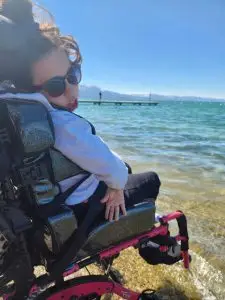
Yes — the Extreme Motus and Hippocampe both float in shallow water with a caretaker holding the chair.
How long does the Motus take to ship?
Typically 2–3 weeks from order. Custom options (color, embroidery) add up to 4 weeks. Free shipping on orders over $375.
Try the Motus before you buy
Ride a Motus on real terrain near you. Feel the weight, test the suspension, see how it loads in your vehicle — all before you commit.
Free demo experience. No pressure. Locations across the U.S.
Request a demo experience →The smartest deal on this list
$4,500. One chair, every terrain. No add-on kits. Real funding paths.
How it all started - Meet Sam & Ryan
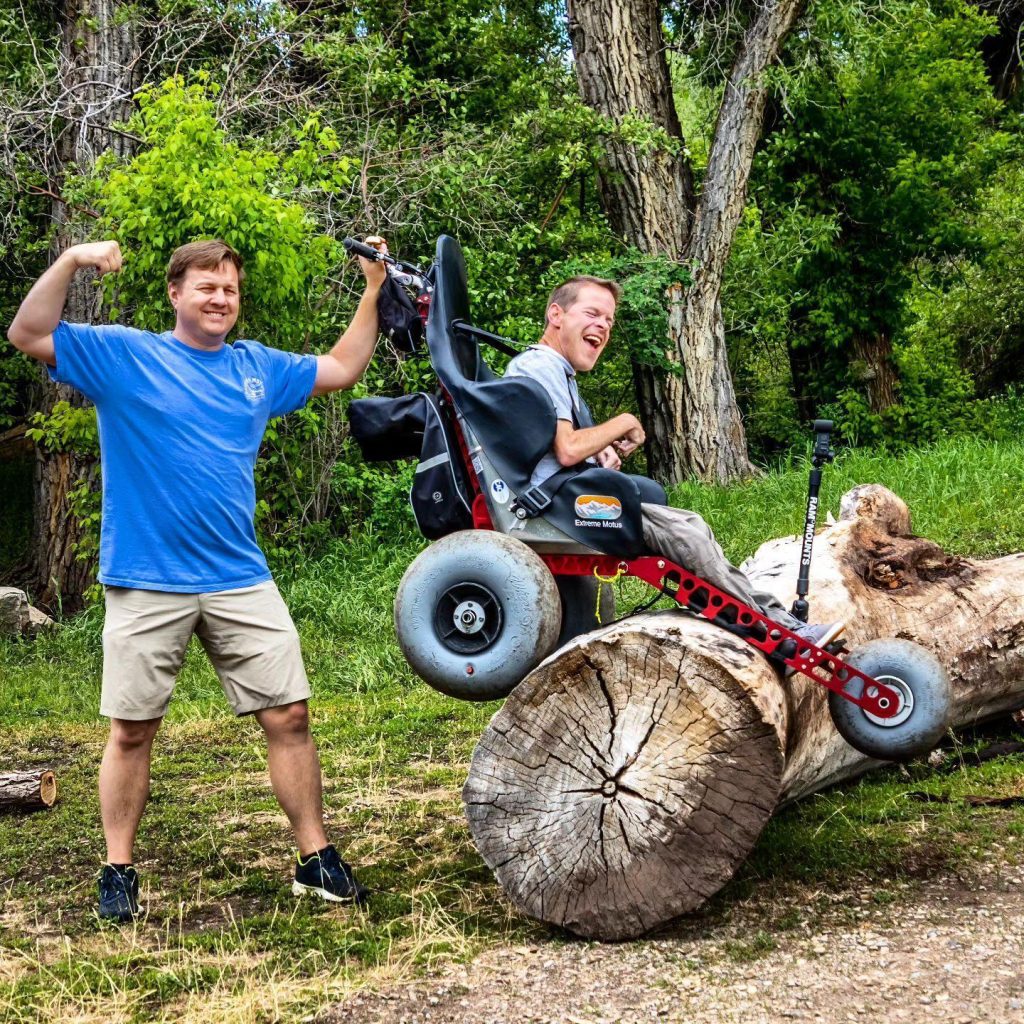
Since 2019, Sam and Ryan have been demonstrating that nature is wheelchair accessible with the Extreme Motus All Terrain Wheelchair. From National Parks to Skateparks, their adventures prove that a manual off-road wheelchair can offer laughter and joy while navigating diverse terrains.
Join us as we continue to share these inspiring journeys.
Discover Freedom with the Extreme Motus All Terrain Wheelchair
Light, comfortable, and compact, the Extreme Motus glides over sand, rocks, grass, gravel, and even floats in water.
It's more than a outdoor wheelchair; it's your ticket to freedom. Embrace the outdoors with confidence, knowing our off-road wheelchair is engineered for durability and ease of use.
Be the first to hear about new gear, upcoming adventures, and exclusive offers. As a welcome gift, you'll get a $100 coupon toward the Motus All-Terrain Wheelchair — delivered straight to your inbox.
By subscribing you agree to receive marketing communications from Extreme Motus, including product updates, promotions, and special offers. I understand I can unsubscribe at any time.