

Find your all-terrain wheelchair
These films tell powerful stories. Which one will you live next? Take the 30-second Adventure Quiz above to find the all-terrain wheelchair built for the trails, beaches, or skateparks you want to tackle.
Quick answer
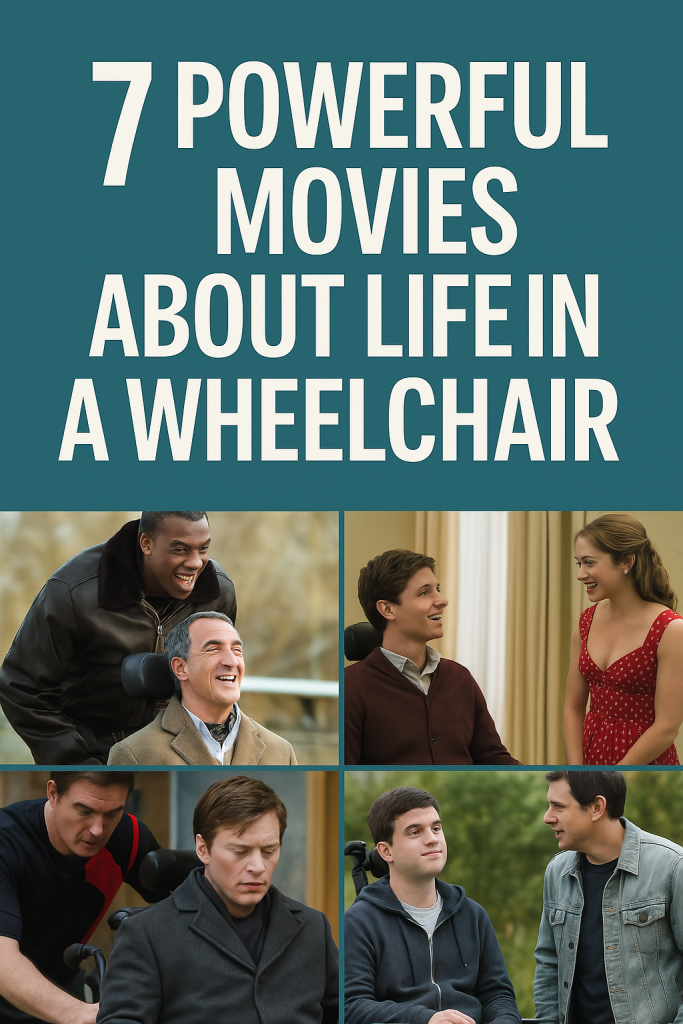
The 7 powerful films are: The Intouchables (2011) · Me Before You (2016) · The Theory of Everything (2014) · Murderball (2005, documentary) · Born on the Fourth of July (1989) · My Left Foot (1989) · The Fundamentals of Caring (2016). Watch them, then meet the everyday riders living their own version near the bottom of this post.
Stories of resilience, courage, and transformation often come from the most unexpected places. These incredible movies highlight characters navigating life in a wheelchair — some based on true stories, others fictional, but all deeply moving. Whether you’re looking for inspiration or a new perspective, these films deliver.
7 Movies About Wheelchairs and Disabilities
1. The Intouchables (2011)
Genre: Comedy-Drama
Country: France
Directors: Olivier Nakache & Éric Toledano
Based on: The true story of Philippe Pozzo di Borgo and Abdel Sellou
Plot Summary:
After a paragliding accident leaves wealthy aristocrat Philippe a quadriplegic, he hires Driss, a charismatic man from the projects who has no caregiving experience and only applied for the job to get his welfare benefits. Against all odds, the two form a bond that’s deeply moving and often hilarious. Driss brings spontaneity and fun into Philippe’s structured, somewhat lifeless routine, while Philippe gives Driss a sense of responsibility and purpose.
What Makes It Work:
- It’s not a typical “inspiration porn” film — it’s full of humor, heart, and humanity.
- The friendship is the centerpiece, not the disability.
- It challenges assumptions about class, race, and what defines a meaningful life.
- The chemistry between Omar Sy (who won a César Award for Best Actor) and François Cluzet is electric.
Its Legacy: Continues to resonate globally as a feel-good story rooted in real-life connection and empathy. One of the most successful French films ever — grossing over $400 million worldwide. Inspired several remakes, including the American version The Upside (2017) starring Kevin Hart and Bryan Cranston.
2. Me Before You (2016)
Genre: Romantic Drama
Director: Thea Sharrock (feature film debut)
Based on: The bestselling novel by Jojo Moyes, who also wrote the screenplay
Plot Summary:
Louisa “Lou” Clark is a quirky, cheerful woman from a small English town who takes a job as a caregiver for Will Traynor, a wealthy young man left paralyzed from the neck down after a motorcycle accident. Will, once an adventurous and successful banker, is now cynical and bitter about his new reality. As Lou tries to bring joy back into his life, an unexpected love story unfolds — but it’s shadowed by Will’s controversial plans for assisted suicide.
Why It Hits Hard:
- It explores complex issues like autonomy, disability, love, and quality of life.
- The emotional connection between Lou and Will challenges the notion that a fulfilling life must look a certain way.
- The film spotlights the emotional and psychological impact of life-altering injury — not just the physical.
Cast Highlights: Emilia Clarke (Lou) brings warmth and wit, a shift from her Game of Thrones persona. Sam Claflin (Will) delivers a nuanced performance showing the internal struggles of someone grappling with disability and despair.
Controversy & Criticism: While popular, the film faced backlash from disability rights activists who criticized its message that life with a disability might not be worth living. Critics argued it romanticized assisted suicide and perpetuated harmful stereotypes about people in wheelchairs lacking purpose or happiness.
Lasting Impact: Despite mixed critical reception, it remains a fan favorite for emotional resonance. Sparked global conversations about disability representation in media and became a cultural touchpoint for debates on love, dignity, and personal choice.
3. The Theory of Everything (2014)
Genre: Biographical Drama
Director: James Marsh
Based on: Travelling to Infinity: My Life with Stephen by Jane Hawking
Plot Summary:
The film chronicles the extraordinary life of Stephen Hawking, the world-renowned theoretical physicist, focusing on his early years at Cambridge, his groundbreaking work on black holes and cosmology, and his battle with ALS (amyotrophic lateral sclerosis). It’s also deeply rooted in his relationship with Jane Wilde Hawking, his first wife, who stood by him through the early and most challenging years of his illness.
The Core of the Film: It’s a story of mind over matter — literally. Hawking’s physical decline contrasts with the boundless nature of his intellectual work. The film humanizes a scientific icon, showing his wit, charm, and struggles. It offers an intimate look at caregiving, love, and resilience from Jane’s perspective.
Performance Highlights: Eddie Redmayne (Stephen Hawking) won the Academy Award for Best Actor for his remarkable transformation. Felicity Jones (Jane Hawking) received critical acclaim and an Oscar nomination for portraying the emotional and physical toll of caregiving.
Famous Quote: “However difficult life may seem, there is always something you can do and succeed at.”
4. Murderball (2005)
Genre: Documentary / Sports
Directors: Henry Alex Rubin & Dana Adam Shapiro
Awards: Sundance Film Festival Audience Award, Academy Award nominee for Best Documentary Feature
Plot Summary:
Murderball dives into the intense world of wheelchair rugby, a sport as brutal and fast-paced as any full-contact game — played by athletes with spinal cord injuries. The film follows Team USA as they prepare for the 2004 Paralympic Games, focusing on rivalries, personal struggles, and the sheer athleticism of its players. The title comes from the sport’s original name before rebranding as “quad rugby.”
Why It Matters: It smashes every stereotype about disability. These men are not fragile — they’re tough, competitive, and passionate. It’s not just about sports — it’s about identity, masculinity, trauma, and pushing past limits. It gives visibility to life after injury, showing how these athletes adapted and thrived.
Standout Figures: Mark Zupan is the film’s breakout star, known for his intensity on and off the court. Joe Soares, a former U.S. player who controversially becomes coach of Team Canada, creates real-life sports drama.
What Sets It Apart: It’s raw and unsentimental — no manipulative music or sugarcoating. Shows the players as real people: they drink, joke, curse, and compete like any other athlete. Highlights how people redefine masculinity and strength through adaptive sports.
Where It Landed: Roger Ebert called it “one of the best documentaries I’ve ever seen.” It inspired many viewers to reconsider what “ability” really means and remains one of the more influential disability-focused documentaries ever made.
→ Love the grit of Murderball?
Wheelchair rugby is its own beast — a contact sport with custom welded chairs. The Motus isn’t a rugby chair, but it’s built with the same no-pity, no-bubble-wrap attitude. Lightweight aluminum, low-pressure tires, designed to take a beating in sand, snow, mud, and rocks. See the Motus in action →
5. Born on the Fourth of July (1989)
Genre: Biographical War Drama
Director: Oliver Stone
Based on: The autobiography Born on the Fourth of July by Ron Kovic
Awards: Won 2 Academy Awards (Best Director, Best Film Editing), nominated for 8 including Best Picture
Plot Summary:
This powerful film tells the true story of Ron Kovic, a patriotic young man who enlists in the U.S. Marines and serves in the Vietnam War. After being paralyzed from the chest down during combat, he returns home to a country that’s both politically divided and emotionally distant. Disillusioned and broken, Ron transforms from a war hero to a passionate anti-war activist and disability rights advocate.
What It Gets Right: It’s not just about war — it’s about what comes after. The trauma, the abandonment, and the fight for dignity. The film explores the psychological impact of paralysis and the isolation many veterans face when reintegrating into society. Ron’s journey from blind patriotism to vocal activism is emotionally gripping and politically charged.
Tom Cruise’s Breakout Role: Cruise gives a career-defining performance, showcasing vulnerability, rage, confusion, and ultimately courage. His physical and emotional portrayal of Kovic’s post-injury life — including hospital scenes, substance abuse, and eventual empowerment — was widely praised and earned him his first Academy Award nomination for Best Actor.
Historical Significance: One of the first major Hollywood films to highlight the long-term consequences of war, especially for disabled veterans. A landmark in the representation of paralysis and disability in cinema. Helped elevate national conversations about the treatment of disabled veterans and VA system failures.
Memorable Line: “People say that if you don’t love America, then get the hell out. Well, I love America.”
6. My Left Foot (1989)
Genre: Biographical Drama
Director: Jim Sheridan
Based on: My Left Foot: The Story of Christy Brown, an autobiography
Plot Summary:
This powerful true story follows Christy Brown, an Irishman born with severe cerebral palsy who could only control one part of his body — his left foot. Despite overwhelming physical limitations and growing up in poverty, Christy defied expectations by becoming a brilliant painter, poet, and novelist. The film traces his childhood struggles, the fierce support of his mother, and his rise as an artist with a uniquely raw and rebellious spirit.
Why It Stands Out: It’s a raw and honest portrayal of living with a disability, without sugarcoating the challenges. The story focuses on Christy’s agency, talent, and voice — not just his condition. It celebrates human resilience, the power of family, and the drive to express oneself against all odds.
Daniel Day-Lewis’s Iconic Performance: Day-Lewis immersed himself in the role, staying in character even off-camera and refusing to break posture throughout filming. He won the Academy Award for Best Actor.
Brenda Fricker’s Role: She played Christy’s devoted and determined mother, winning the Oscar for Best Supporting Actress. Her character is a pillar of strength, refusing to let her son be written off.
Themes: Art as liberation — Christy found freedom and identity through writing and painting. Family and perseverance — his mother’s belief in him shaped his destiny. Rejection of pity — Christy is portrayed as proud, fiery, and fiercely independent.
7. The Fundamentals of Caring (2016)
Genre: Comedy-Drama / Road Trip
Director: Rob Burnett
Based on: The novel The Revised Fundamentals of Caregiving by Jonathan Evison
Streaming: Netflix
Plot Summary:
Ben, a recently divorced writer coping with personal tragedy, takes a job as a caregiver for Trevor, an 18-year-old with Duchenne muscular dystrophy. Sarcastic and sheltered, Trevor has a strict routine — until Ben convinces him to take an epic road trip. Along the way, they meet quirky characters, face fears, and develop a deep, unlikely friendship that helps both of them heal.
The Takeaway: It blends humor and heart while tackling serious themes like grief, disability, and emotional isolation. It highlights how caregiving can be a two-way street — both the caregiver and the person receiving care grow together. It’s about breaking routines, facing the world, and learning to live fully — even with limitations.
Cast Highlights: Paul Rudd (Ben) balances comedy and compassion perfectly. Craig Roberts (Trevor) delivers a sharp, hilarious, and layered performance. Selena Gomez (Dot) is a tough, independent hitchhiker who becomes part of their makeshift family on the road.
Representation of Disability: Trevor’s character is written with agency — he’s not defined by his condition, and the story never turns him into a pity figure. The film avoids clichés and portrays the challenges of muscular dystrophy realistically while maintaining a light, optimistic tone.
→ Want a Trevor-style road trip without the pavement limit?
Trevor’s adventure was huge — but he was tied to the parking lot. Sam and I built our routine around the kind of trips Trevor never got: the Bonneville Salt Flats, Spiral Jetty, Bryce Canyon. The Motus is the chair that lets your road trip end where the trail begins, not where the sidewalk does. See the Motus →
Don’t Wait for the Movie — Start Your Own Adventure
Hollywood loves a story with a wheelchair in it — but the gap between watching the story and living it is the whole point.
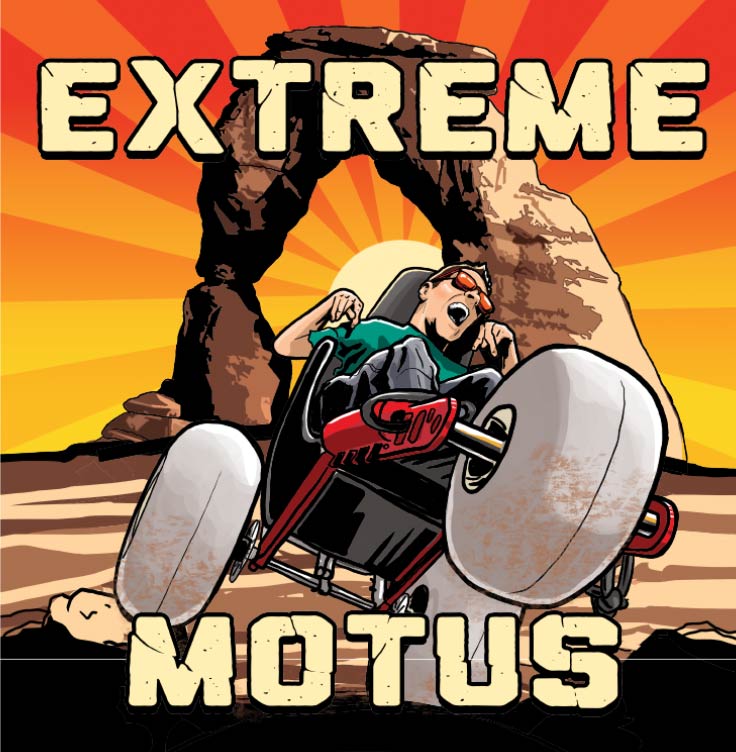
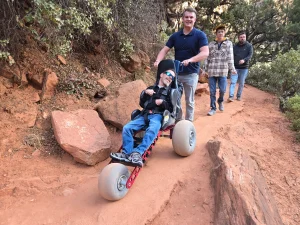
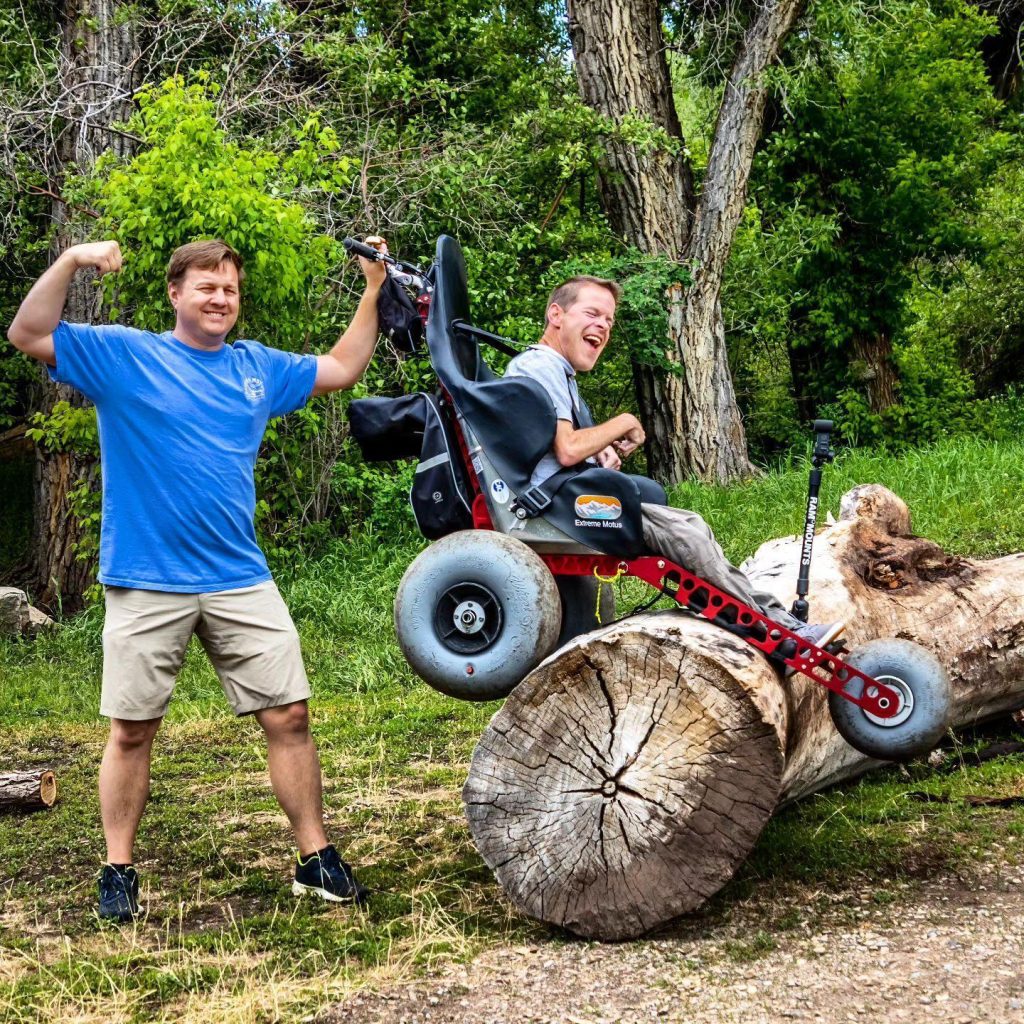
Sam and I aren’t waiting for the cameras. We’re best friends of 30+ years (no, we’re not actually brothers). I’m Sam’s caregiver. We’ve taken the Extreme Motus all-terrain wheelchair to Delicate Arch, the Bonneville Salt Flats, a Utah skatepark (where Sam earned the nickname “Tony Hawking”), a 6-mile waterfall hike that nearly killed me, and YouTube.
None of this happened because we waited. It happened because we got the right chair and went.
Hollywood Might Not Be Calling Yet
But the mountains are. Take the 30-second Adventure Quiz and find the all-terrain wheelchair built for the trail you’ve been thinking about.
Real Reviews from Real Riders
The films above tell stories. These are stories from people who’ve actually used the Motus.
★★★★★
“Caitlin thoroughly enjoyed the entire hike and loves it when family and friends help with the ropes we’ve attached for the steeper inclines. Her chair is also a lifesaver when trekking across the wide sandy beaches of the Florida Gulf Coast. We’re glad you all came up with this ‘hiking chair.'”
— Darren, Crater Lake & Florida Gulf Coast
★★★★★
“Every time our son gets to be included in an activity he previously wouldn’t have been is a new favorite. He has gone to a beach, hiking in the woods, an apple orchard, an arboretum, many trails, and most importantly our backyard — which was not suitable for his everyday wheelchair.”
— Courtney, Motus Family
More stories: Kevin & Jacque (Hawaii to Zion) · The Dursts · Henry Evans (brainstem stroke survivor)
Frequently Asked Questions
What movie best portrays wheelchair life authentically?
My Left Foot and Murderball both excel. My Left Foot is unflinching about Christy Brown’s lived experience — showing struggle without sentimentality. Murderball strips away all pity and shows wheelchair users as complex, competitive, flawed people. Neither falls into inspiration porn.
Are these documentaries or dramas?
Six are narrative dramas based on true stories: The Intouchables, Me Before You, The Theory of Everything, Born on the Fourth of July, My Left Foot, and The Fundamentals of Caring. Murderball is a documentary. Both formats offer powerful perspectives.
Which films feature actual disabled actors?
Murderball features real wheelchair rugby athletes. The others cast able-bodied actors in lead roles, which has been controversial. We believe in authentic representation, which is why our brand is built around Sam and Ryan — real friends, real adventures, no acting required. Watch their adventures on YouTube →
Are any of these movies depressing or suicidal?
Me Before You explicitly deals with assisted suicide and is emotionally heavy. If that’s a trigger, start with The Intouchables, Murderball, or The Fundamentals of Caring, which are lighter in tone while still meaningful.
Can I watch these with family?
Murderball (PG-13), The Fundamentals of Caring (R, but appropriate for teens), and The Intouchables (R, but light-hearted) are more family-friendly. Born on the Fourth of July, My Left Foot, and Me Before You contain adult themes and are best for mature audiences.
Where can I watch them?
The Fundamentals of Caring streams on Netflix. Most others are available on major streaming services (Netflix, Amazon Prime, Apple TV, Hulu) or for purchase/rent. Check JustWatch for current availability in your region.
What kind of wheelchair would I need to actually do trips like these?
For trails, beaches, snow, and uneven outdoor terrain, you need an all-terrain wheelchair, not a standard medical one. The Extreme Motus is 55 lbs, $4,500, fits in a sedan trunk, and floats. Take the Adventure Quiz at the top of this post to see how it compares to 12 other off-road chairs. Funding paths exist too — see our grants guide and financing options.
Stop watching. Start writing your story.
The credits don’t have to roll on your adventures.
How it all started - Meet Sam & Ryan
Since 2019, Sam and Ryan have been demonstrating that nature is wheelchair accessible with the Extreme Motus All Terrain Wheelchair. From National Parks to Skateparks, their adventures prove that a manual off-road wheelchair can offer laughter and joy while navigating diverse terrains.
Join us as we continue to share these inspiring journeys.
Discover Freedom with the Extreme Motus All Terrain Wheelchair
Light, comfortable, and compact, the Extreme Motus glides over sand, rocks, grass, gravel, and even floats in water.
It's more than a outdoor wheelchair; it's your ticket to freedom. Embrace the outdoors with confidence, knowing our off-road wheelchair is engineered for durability and ease of use.
Be the first to hear about new gear, upcoming adventures, and exclusive offers. As a welcome gift, you'll get a $100 coupon toward the Motus All-Terrain Wheelchair — delivered straight to your inbox.
By subscribing you agree to receive marketing communications from Extreme Motus, including product updates, promotions, and special offers. I understand I can unsubscribe at any time.