

Quick answer: Parkinson’s affects approximately 10 million people worldwide, causing progressive motor control challenges. About 90,000 new cases are diagnosed annually in the U.S. While there’s no cure, outdoor activity combined with proper mobility tools helps manage symptoms and improve quality of life—and all-terrain wheelchairs make trail and beach access possible when standard mobility aids fail.
Parkinson’s Disease is a progressive neurological disorder affecting movement, coordination, and balance. But outdoor time paired with the right mobility equipment can dramatically improve both physical and mental well-being. Here’s what you need to know about Parkinson’s and how to stay active outdoors.
1. What Is Parkinson’s Disease and What Causes It?
Parkinson’s Disease occurs when nerve cells in the brain’s substantia nigra fail to produce enough dopamine, a neurotransmitter essential for movement. Without adequate dopamine, the brain struggles to coordinate muscle control, leading to tremors, stiffness, and slowed movement.
Risk factors include:
- Age: Risk increases significantly after age 60.
- Gender: Men are 1.5 times more likely to develop Parkinson’s.
- Family History: Genetic mutations increase risk, though most cases are not inherited.
- Environmental Exposure: Pesticide and heavy metal exposure may contribute.
2. How Many People Are Affected by Parkinson’s Disease?
Parkinson’s Disease affects approximately 10 million people worldwide. In the United States, about 90,000 new cases are diagnosed annually, making it the second most common neurodegenerative disorder after Alzheimer’s disease.
3. What Are the Primary Symptoms?
Parkinson’s symptoms vary by individual and typically develop gradually. Early recognition helps with faster diagnosis and symptom management.
- Tremors – Usually starting in hands or fingers at rest
- Bradykinesia – Slowed movement and difficulty initiating motion
- Muscle Rigidity – Stiffness throughout limbs and trunk
- Postural Instability – Poor balance and increased fall risk
- Non-Motor Symptoms – Depression, sleep disorders, cognitive decline, and pain
4. What Treatments Are Available?
Although there is no cure, treatments manage symptoms effectively and help maintain quality of life.
- Medications: Levodopa (L-DOPA) replenishes dopamine; dopamine agonists and MAO-B inhibitors enhance dopamine effects
- Physical and Occupational Therapy: Maintain mobility, strength, and independence in daily tasks
- Speech Therapy: Address communication and swallowing changes
- Deep Brain Stimulation (DBS): Surgical option for advanced cases to regulate brain activity
5. Why Outdoor Activity Matters for Parkinson’s
Nature is medicine for Parkinson’s. Outdoor time delivers measurable physical and emotional benefits:
- Improves Motor Function: Gentle movement combats stiffness and bradykinesia
- Reduces Stress and Anxiety: Natural environments lower cortisol and boost serotonin
- Combats Depression: Sunlight exposure and outdoor engagement improve mood significantly
- Strengthens Social Connection: Family and friend outings prevent isolation and boost mental resilience
6. The Challenge: Terrain Access
Standard wheelchairs and walkers are designed for smooth pavement. Grass, gravel, dirt trails, sand, and uneven ground present significant barriers for people with Parkinson’s—who often have balance issues, tremors, and fatigue. This limits outdoor participation and independence exactly when outdoor time matters most.
7. How an All-Terrain Wheelchair Changes the Game
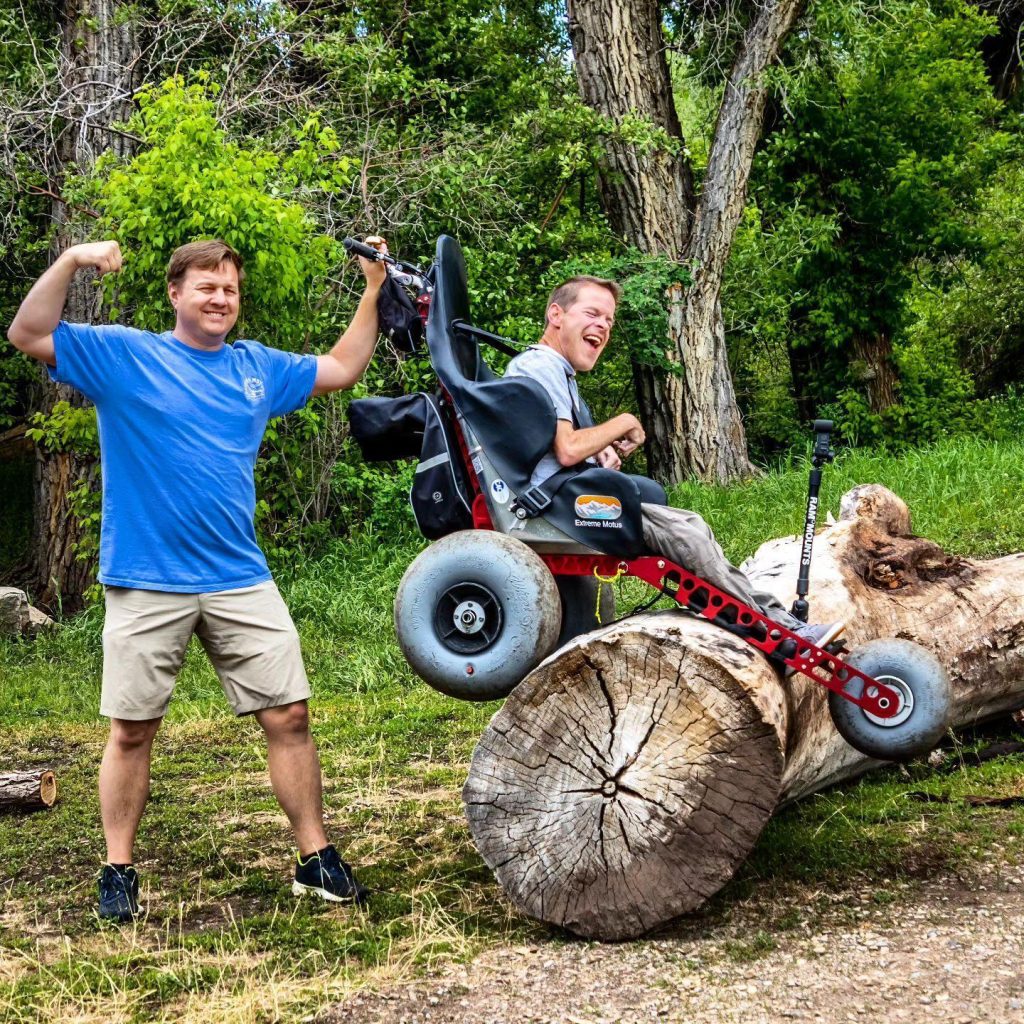
An all-terrain wheelchair like the Extreme Motus removes terrain barriers entirely:
- Navigates Any Surface: Handles trails, beaches, gravel, sand, grass—unlocking parks and nature once off-limits
- Shock Absorption: Large low-pressure tires absorb jolts, reducing tremor impact and providing a smooth ride
- Stability and Safety: Prevents falls and offers secure seating for users with balance challenges
- Independence: Reduces caregiver reliance; users explore confidently without constant physical support
- Social Participation: Family hikes, beach trips, and outdoor adventures become genuinely accessible
Frequently Asked Questions
Is Parkinson’s hereditary?
Most Parkinson’s cases are not inherited. However, genetic mutations (like LRRK2 and GBA) increase risk. If a parent or sibling has Parkinson’s, your risk is higher but not certain. Family history plus environmental triggers may combine to trigger onset.
Can exercise help manage Parkinson’s symptoms?
Yes, strongly. Regular exercise—walking, swimming, tai chi, dancing—improves motor control, balance, and mood. Outdoor activity combines exercise benefits with stress reduction and social connection, making it ideal for Parkinson’s management.
What is post-Parkinson syndrome, and is it different from Parkinson’s?
There is no formal “post-Parkinson syndrome.” However, long-term Parkinson’s can progress to advanced stages with more severe motor and non-motor complications. Early intervention and ongoing treatment help slow progression and manage complications.
At what age does Parkinson’s typically develop?
Average onset is around 60 years old, though “young-onset” Parkinson’s (before age 50) affects about 5-10% of cases. Early diagnosis and treatment provide better long-term outcomes.
Can I still travel with Parkinson’s?
Yes. Travel requires planning—bring medications, avoid extreme heat or cold, pace activities, and rest when needed. An all-terrain wheelchair expands travel options by making outdoor destinations genuinely accessible, not just theoretically available.
What mobility devices work best for Parkinson’s?
Choices depend on symptom severity: walkers and canes help early stages; standard wheelchairs address advanced mobility loss on pavement. For outdoor terrain—trails, parks, beaches—an all-terrain wheelchair is the only practical option that maintains independence.
Conclusion
Parkinson’s Disease presents real challenges, but outdoor time is one of the most powerful tools for managing symptoms, improving mood, and maintaining quality of life. When terrain becomes a barrier, an all-terrain wheelchair restores access and independence. Living with Parkinson’s doesn’t mean staying indoors—with the right tools and support, outdoor adventure remains fully within reach.
Ryan Grassley · ryan@extrememotus.com
How it all started - Meet Sam & Ryan
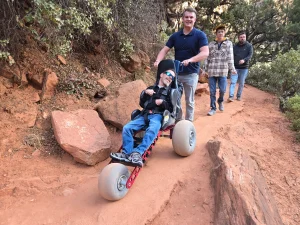
Since 2019, Sam and Ryan have been demonstrating that nature is wheelchair accessible with the Extreme Motus All Terrain Wheelchair. From National Parks to Skateparks, their adventures prove that a manual off-road wheelchair can offer laughter and joy while navigating diverse terrains.
Join us as we continue to share these inspiring journeys.
Discover Freedom with the Extreme Motus All Terrain Wheelchair
Light, comfortable, and compact, the Extreme Motus glides over sand, rocks, grass, gravel, and even floats in water.
It's more than a outdoor wheelchair; it's your ticket to freedom. Embrace the outdoors with confidence, knowing our off-road wheelchair is engineered for durability and ease of use.
Be the first to hear about new gear, upcoming adventures, and exclusive offers. As a welcome gift, you'll get a $100 coupon toward the Motus All-Terrain Wheelchair — delivered straight to your inbox.
By subscribing you agree to receive marketing communications from Extreme Motus, including product updates, promotions, and special offers. I understand I can unsubscribe at any time.