

Quick answer
Six pieces of genuinely innovative mobility equipment worth knowing about right now: the Scewo BRO (a power wheelchair that climbs stairs), the ReWalk 7 Personal Exoskeleton (now covered by Medicare and three major Medicare Advantage insurers), the Permobil F5 Corpus VS (a power wheelchair that stands you up), the WHILL Modo Breeze (a brand-new carbon-fiber ultralight power chair), hands-free drive controls for people who can’t use a joystick, and power-assist add-on wheels that turn a manual chair into an e-bike on hills.
We build a simple, rugged, all-terrain manual wheelchair on purpose — no batteries to charge, nothing to short out in salt water or sand. But we’re just as obsessed with innovative mobility equipment as anyone, and the assistive equipment space has never moved faster. Some of what’s shipping right now sounds like science fiction: wheelchairs that climb stairs on their own, exoskeletons that let paralyzed users walk through a stadium, chairs that stand you up to eye level mid-conversation.
Here are six pieces of innovative mobility equipment that are actually available today — not concepts, not Kickstarters — that are changing what “mobility equipment” means.
1. Scewo BRO — the wheelchair that climbs stairs
The Scewo BRO is a Swiss-made power wheelchair that balances and drives on two large wheels like a self-balancing scooter, then switches into a tracked “stair mode” to climb straight staircases at the push of a button. It’s been featured on CNN, the BBC, and the Wall Street Journal’s CES coverage, and it isn’t a prototype — it’s a CE-marked medical device already in use across Europe.
- Stair climbing: up to a 36° incline, 30 steps per minute, obstacles up to 20 cm (about 8 inches)
- Driving mode: up to 10 km/h (6.2 mph), 25–35 km range, turns in place, clears 5 cm curbs and obstacles
- Seat lift: raises or lowers the seat between roughly 44 cm and 89 cm, so you can reach a top shelf or sit at eye level at a bar
- Control: joystick or a smartphone app — including a remote-control mode that lets you drive BRO into your car’s trunk by itself
- Weight capacity: approximately 88–265 lbs (40–120 kg), with adjustments available for lighter users
It’s not cheap and it’s not for every stair situation (spiral staircases are out, and it needs a landing at least 47 inches square) — but for someone whose biggest daily barrier is a flight of stairs at home or a curb with no ramp, it’s a genuinely different category of innovative mobility equipment.
2. ReWalk 7 Personal Exoskeleton — walk again, and Medicare may help pay for it
Lifeward’s ReWalk 7 Personal Exoskeleton is a wearable robotic exoskeleton for people with spinal cord injuries (levels T4–L5) that powers the hips and knees so users can stand, walk, turn, and climb or descend stairs and curbs — all FDA-approved for home and community use.
The big news for 2026: the ReWalk Personal Exoskeleton was assigned to Medicare’s brace benefit category back in January 2024, and as of February 2026, three of the largest Medicare Advantage insurers — Aetna, UnitedHealthcare, and Humana, representing roughly 16 million beneficiaries combined — have issued prior authorizations for qualifying users. That’s a real shift from “cool tech nobody can afford” to “tech insurance is starting to pay for” — one of the clearest signs yet that this kind of innovative mobility equipment is going mainstream.
- New in the ReWalk 7: crutch-mounted controls, two customizable walking speeds, a smartwatch display, a companion app, and an upgraded clinician training tool
- Reported health benefits from published studies include improved spasticity, trunk control, bowel and bladder function, circulation, pain management, and mental health
- Coverage: Medicare (where medically necessary) plus a growing list of Medicare Advantage plans as of 2026
3. Permobil F5 Corpus VS — the power wheelchair that stands you up
The Permobil F5 Corpus VS is a power standing wheelchair — it drives like a normal power chair, then transitions you into a standing position using a programmable sequence (supine, semi-reclined, or sit-to-stand, depending on what your body needs).
- Weight capacity: up to 300 lbs
- Speed: up to 5.8 mph (Group 3) or 7.5 mph (Group 4)
- ActiveReach & ActiveHeight: up to 45° of forward tilt and 14 inches of seat elevation, so you can reach a high shelf or get to eye level without standing fully
- Connected features: the MyPermobil smartphone app shows battery level, predicted range, and seating data in real time; built-in connectivity supports remote diagnostics and service
Standing isn’t just convenience — for many wheelchair users it’s tied to bone density, circulation, digestion, and pressure sore prevention, so a chair that fits standing time into daily driving (rather than requiring a separate standing frame) is a meaningful upgrade for anyone shopping for innovative mobility equipment.
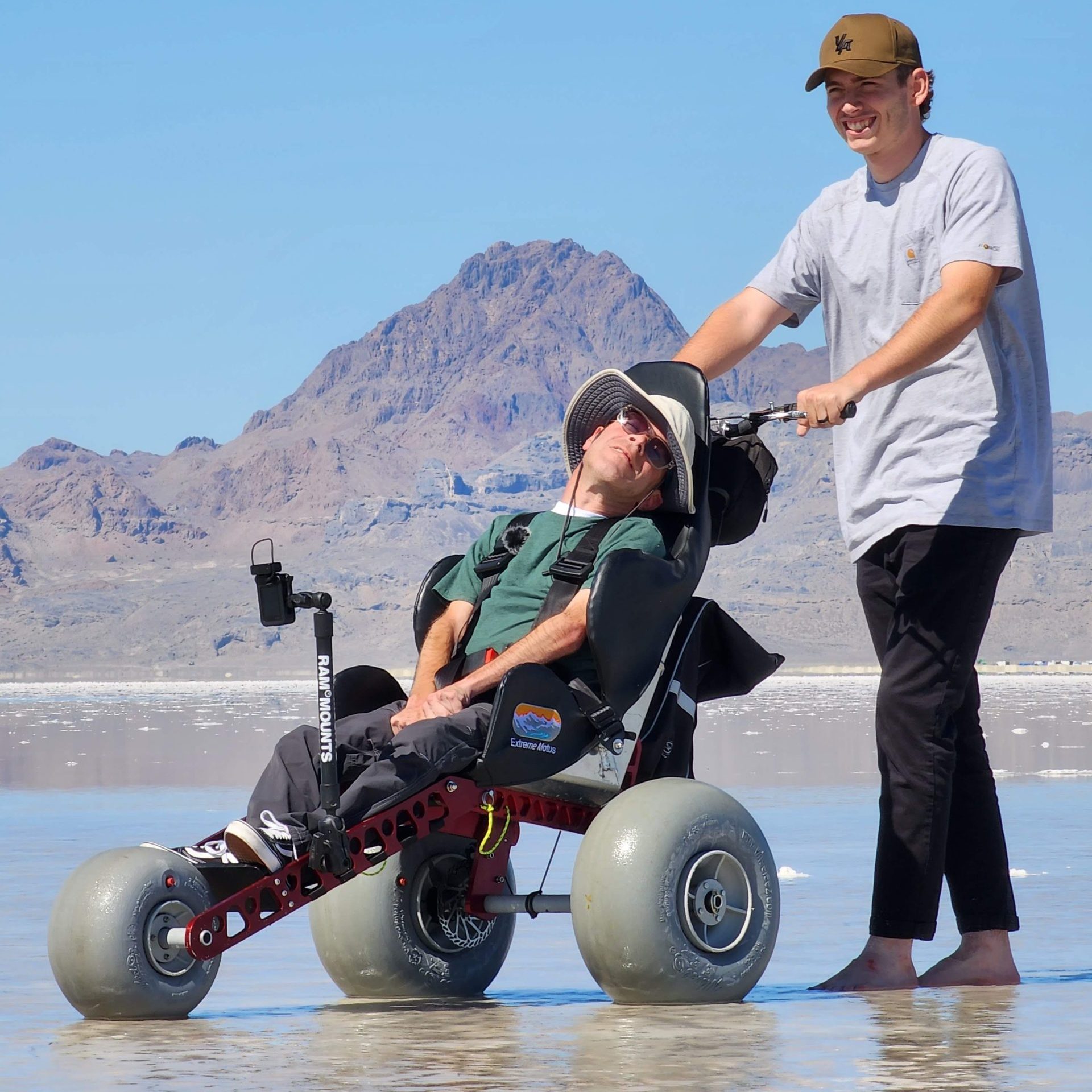
Try the Motus before you buy
Ride a Motus on real terrain near you. Feel the weight, test the suspension, see how it loads in your vehicle — all before you commit.
Free demo experience. No pressure. Locations across the U.S.
Request a demo experience →4. WHILL Modo Breeze — a carbon-fiber ultralight power chair (brand new)
WHILL introduced the Modo Breeze in July 2026 — a carbon-fiber, ultra-lightweight, foldable electric wheelchair aimed at people who want power assistance without the bulk and weight of a traditional power chair. It joins WHILL’s existing Model C2 and Model F lines, which are already known for handling grass, gravel, and light trail terrain better than a typical portable power chair.
WHILL is also worth knowing for a completely different reason: its Autonomous Service — self-driving WHILL devices that shuttle passengers through airports — has now completed over 700,000 rides worldwide, a good reminder that “mobility tech” isn’t limited to the device you own personally.
5. Hands-free drive controls for limited hand function
Not every mobility barrier is about legs. For people with high-level spinal cord injuries, ALS, muscular dystrophy, or other conditions that limit hand strength or range of motion, standard power-chair joysticks can be a dead end — but they don’t have to be. Manufacturers like Permobil offer alternative drive controls that put full power-chair control back within reach:
- Head arrays: pads mounted near the head that steer the chair when you press against them with light head movements
- Sip-and-puff systems: drive by inhaling and exhaling through a strawlike tube — no hand or arm movement required at all
- Micro-joysticks: ultra-sensitive joysticks (like the mo-vis Micro Joystick) that respond to very small or weak hand movements a standard joystick would miss
If you or a family member has been told a power chair “won’t work” because of hand function, it’s worth asking a seating clinic specifically about these alternative controls — they open up independent power mobility to a much wider range of people than most buyers realize.
6. Power-assist add-on wheels — turn a manual chair into an e-bike on hills
Power-assist add-ons clip onto or replace the rear wheels of an existing manual wheelchair and give each push a boost — essentially turning a manual chair into something closer to a pedal-assist e-bike. Products in this category, like Permobil’s SmartDrive and Alber’s e-motion, are built for manual wheelchair users who don’t want or need a full power chair, but who want hills, long distances, or tiring days to cost less energy. They typically fold away or detach when you don’t need the assist, so the chair stays lightweight and manual the rest of the time.
Where does an all-terrain wheelchair fit in?
None of these six pieces of innovative mobility equipment are built for sand, mud, or singletrack — that’s a different job, and it’s the one the Extreme Motus is built for. We keep our chair manual and electronics-free on purpose, because the trade-off for all this incredible technology is complexity: batteries, software, service centers, and things that can fail exactly when you’re farthest from help. Plenty of our customers own an Extreme Motus for the trail and a high-tech power chair, standing chair, or exoskeleton for daily life — they solve different problems.
Innovative Mobility Equipment: Frequently Asked Questions
What is the most advanced wheelchair technology available today?
Two categories lead the pack: stair-climbing power wheelchairs like the Scewo BRO, which balances and drives on two wheels and climbs stairs on command, and robotic exoskeletons like the ReWalk 7, which let people with spinal cord injuries stand up and walk using powered hip and knee joints.
Is a robotic exoskeleton covered by insurance?
The ReWalk Personal Exoskeleton has been assigned to Medicare’s brace benefit category since January 1, 2024, and is covered where reasonable and necessary. As of early 2026, three of the largest Medicare Advantage insurers — Aetna, UnitedHealthcare, and Humana — have issued prior authorizations for qualifying spinal cord injury patients. Coverage still depends on your specific plan and medical necessity documentation.
What if I can’t use a standard wheelchair joystick?
Power wheelchairs can be fitted with alternative drive controls for people with limited hand function, including head arrays, sip-and-puff systems, and micro-joysticks that respond to very light or limited hand movement.
Does the Extreme Motus all-terrain wheelchair include any of this technology?
No — the Extreme Motus is intentionally a simple, manual, all-terrain wheelchair with no batteries or electronics, which is exactly why it never breaks down miles from the trailhead. The gadgets in this guide solve different problems, and many owners use both a manual all-terrain chair and one of these devices depending on the day.
Know of another piece of innovative mobility equipment we should feature next? Email ryan@extrememotus.com — we’re always looking to profile gear that helps people get more out of life.


How it all started - Meet Sam & Ryan
Since 2019, Sam and Ryan have been demonstrating that nature is wheelchair accessible with the Extreme Motus All Terrain Wheelchair. From National Parks to Skateparks, their adventures prove that a manual off-road wheelchair can offer laughter and joy while navigating diverse terrains.
Join us as we continue to share these inspiring journeys.
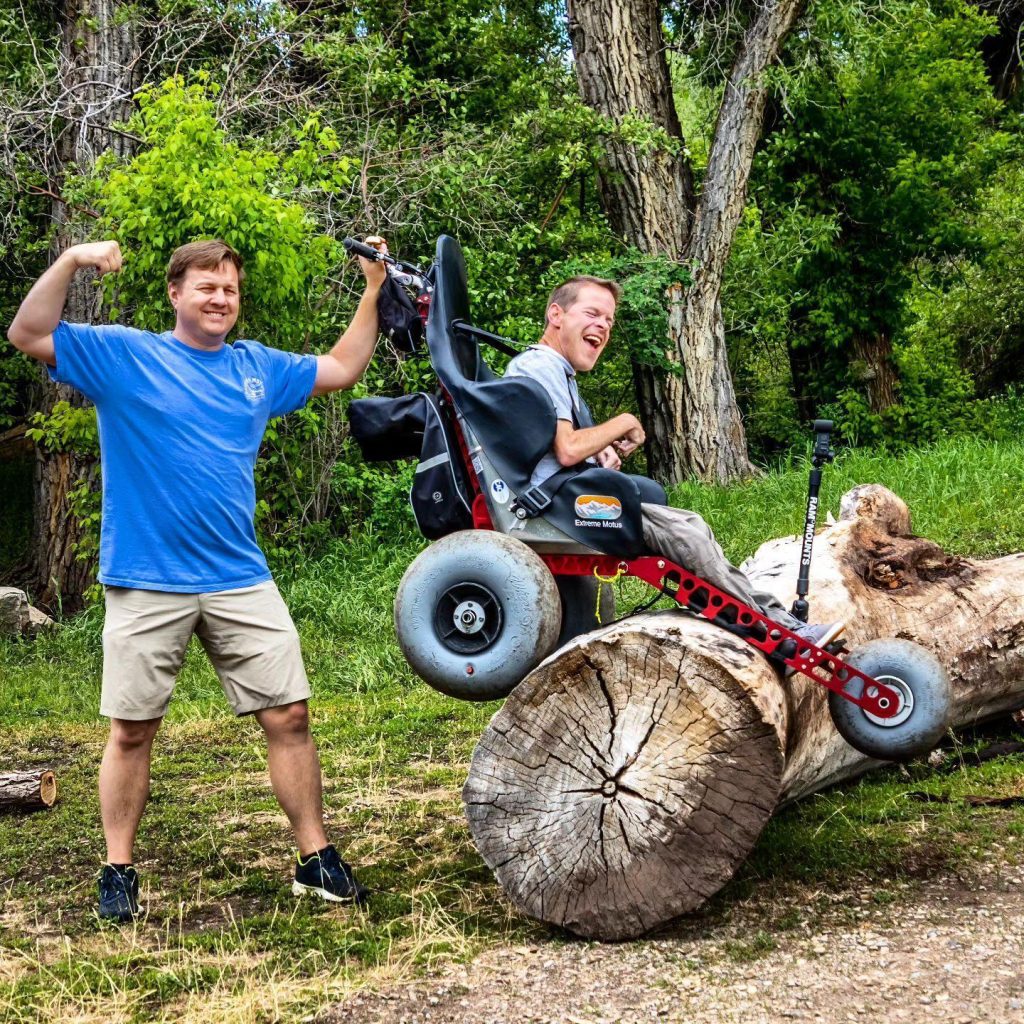
Discover Freedom with the Extreme Motus All Terrain Wheelchair
Light, comfortable, and compact, the Extreme Motus glides over sand, rocks, grass, gravel, and even floats in water.
It's more than a outdoor wheelchair; it's your ticket to freedom. Embrace the outdoors with confidence, knowing our off-road wheelchair is engineered for durability and ease of use.
Be the first to hear about new gear, upcoming adventures, and exclusive offers. As a welcome gift, you'll get a $100 coupon toward the Motus All-Terrain Wheelchair — delivered straight to your inbox.
By subscribing you agree to receive marketing communications from Extreme Motus, including product updates, promotions, and special offers. I understand I can unsubscribe at any time.