

Quick answer: The best way to push a wheelchair on trails is to keep your rider’s weight centered and lean into hills instead of arm-muscling them. Use the brake any time you stop on a slope. Scout anything you can’t see past. Most trail trouble comes from rushing, not from the terrain.
Every accessibility article is written for the rider. That makes sense, since it’s their adventure. But on most trails, someone is behind the chair doing the pushing, and nobody teaches that person how to push a wheelchair on trails.
Sam and I have gotten in over our heads on many adventures. Most of the time we find that other hikers are happy to jump in and help with the adventure.
This is the guide we wish someone had handed us when we started adventuring with the Extreme Motus all terrain wheelchair.
Before You Leave the Trailhead
Know the trail, not just the destination. Look up the grade, the surface, the trail width, and the elevation gain. AllTrails lists elevation profiles and recent conditions for most routes. A two-mile trail with 600 feet of climbing is a different day than a flat two-mile loop. Our national park accessibility guides break this down for specific trails.
One thing I know about hiking is that the trail never gets better. If it starts out steep it’s going to get steeper, if it’s a little wet at the trail head it’s going to be a mud hole further up. It’s something I love to joke about on the trail. “Okay guys that’s the worst of it. Should be easier from here on out.” Even though I know we’re about to descend into the depths of hell.
Check the chair. Look at tire pressure, test the brake, and make sure nothing is loose. It takes two minutes at the car. On mile three, you’re fixing it with a rock. (See how to repair a flat Wheeleez tire and using the Motus parking brake.)
Talk to your rider. Agree on signals for “stop,” “slow down,” and “I’m uncomfortable.” Your rider feels bumps you don’t. Treat them as your co-pilot, not your cargo.
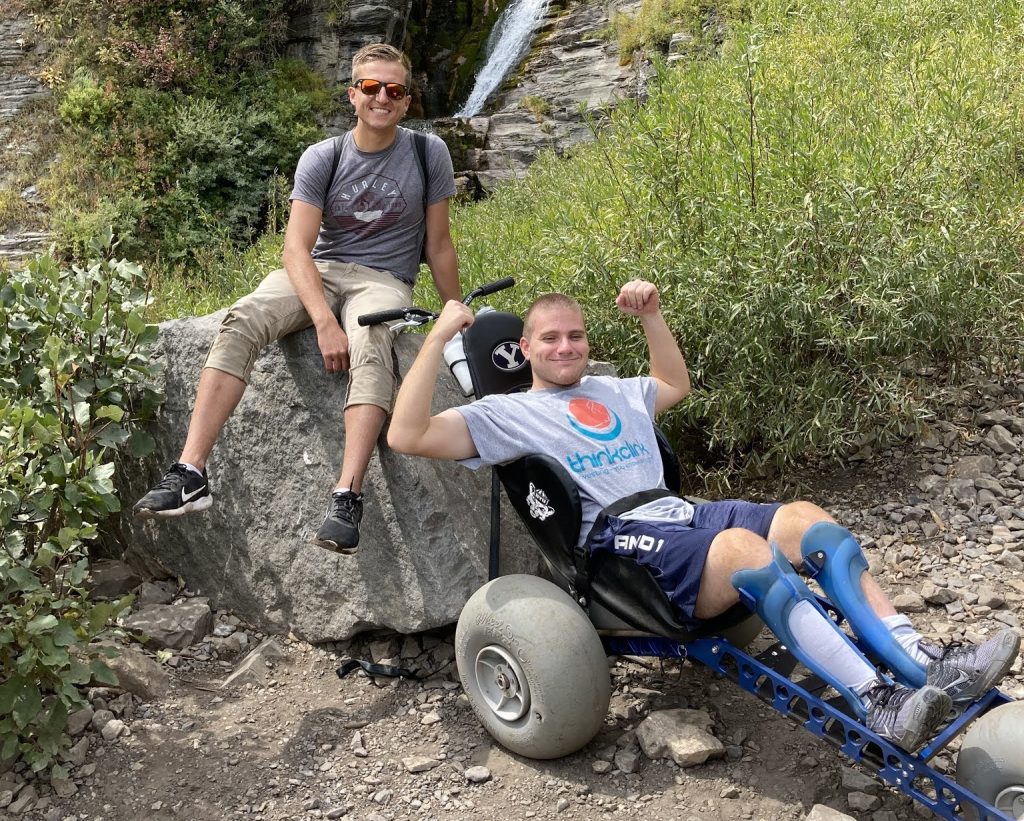
How to Push a Wheelchair on Trails Without Wrecking Your Back
Push with your legs, not your arms. Stand close to the handles, keep your elbows slightly bent, and lean in so your body weight does the work. If your shoulders are burning after 20 minutes, you’re arm-pushing.
Shorten your stride on rough ground. Small, steady steps give you more control than big strides that make the chair lurch.
Take breaks before you need them. Stop on flat ground, set the brake, and drink some water. Pushing uphill for an hour is real exercise. Pace it like a hike, because that’s what it is.
Uphill
Lean forward, keep your arms firm, and drive with your legs. On long climbs, switchbacking across a wide trail reduces the effective grade. If a grade is steep enough that you’re losing ground, it’s time for more help. There’s no shame in that. It’s physics.
Our most difficult climb was probably the hike to Kyhv Peak in Provo, UT. It was so steep and with only myself and Sam’s cousin we couldn’t make it to the top.
Downhill
When you push a wheelchair on trails, downhill is where accidents happen, because gravity wants to take over. Stay behind the chair and keep a firm grip. Control your speed the whole way down instead of letting it build and then braking hard. The brakes on the Extreme Motus will do a great job on the downhill. Also be sure to wear the safety tether around your wrist so the chair and your rider can’t get away if there is an accident.
Roots, Rocks, and Ledges
Scout first. If you can’t see what’s past an obstacle, walk ahead and look.
Approach head-on. Hitting an obstacle at an angle is how chairs tip sideways.
Lift, don’t ram. For small ledges and roots, pop a wheelie and get the front wheel over the obstacle. Then push and lift the back wheels up and over. We have used this method to tackle large rocks and logs blocking the trail.
Know when to go around. The best line isn’t always the straight one.
Sand, Mud, and Snow
Soft surfaces sink narrow wheels, and that’s why tire width matters more than anything else here. Keep momentum, avoid sharp turns, and don’t stop in the deepest part. For a full comparison, see our guide to beach wheelchairs and our sand and snow testing.
Teamwork on Really Hard Trails
Some trails are too much for one person, no matter how strong you are. Delicate Arch is a good example: steep slickrock, sustained climbing, and a lot of it. For trails like that, bring a team.
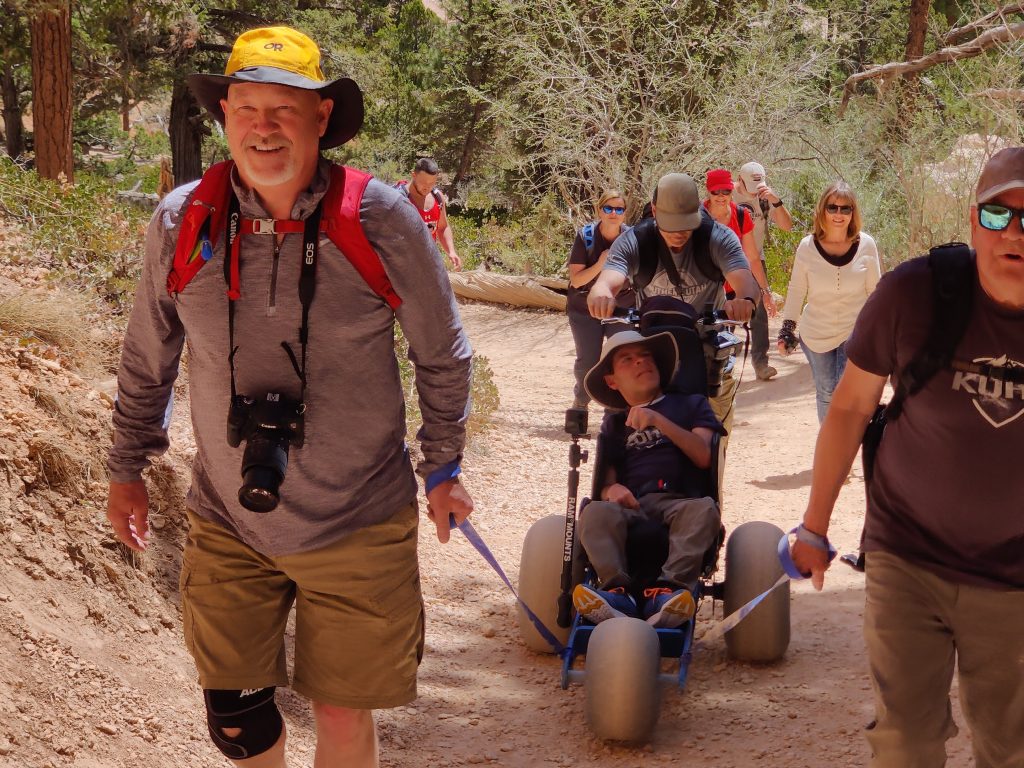
The four-person setup: two people push on the handlebars, and two people up front pull ropes attached to the chair. The pullers take much of the strain off the climb, and the pushers handle steering and control. Together, a trail that would stop one person cold becomes doable.
The mistake every team makes: When you’re one of four people moving a chair, you don’t feel like you’re doing enough. So you speed up a little. Then the person next to you has to speed up to keep pace. Then the pullers up front speed up because the chair is suddenly pushing them. Before long, you’re all basically running up the mountain, and everyone is gassed halfway to the top.
I’ve had to slow the team down many times when pushing Sam. Maybe I’m just old and slow, but going too fast is a great way to wear out everyone in the team.
The fix: pick a steady pace before you start, and stick to it. It will feel too slow, and that’s the point. If it helps, have one person call the pace, like a coxswain for a very dusty rowing team.
Bring extra help for:
- Grades one person can’t push the chair on
- Stream crossings, or ledges taller than your wheels can roll over
- Long days where you’ll be exhausted on the way back, which is when mistakes happen
With the right team, (and enough profanity) you can get just about anywhere.
The Right Chair Makes the Biggest Difference
Trying to push a wheelchair on trails in a standard hospital chair is miserable for both of you. The small front casters catch on everything. An all-terrain wheelchair is built for this: wider tires, a stronger frame, and handles designed for pushing over rough ground. The Extreme Motus weighs 55 pounds, so it goes where you go, including the trunk of your car.
If you’re comparing options, start with our guide to choosing the right all-terrain wheelchair or the 2026 price guide.
The Real Secret
After 8+ years of pushing Sam up mountains, across salt flats, and through a haunted forest, here’s what matters most when you push a wheelchair on trails: go slow enough to enjoy it. The point was never the summit. It’s being out there together.
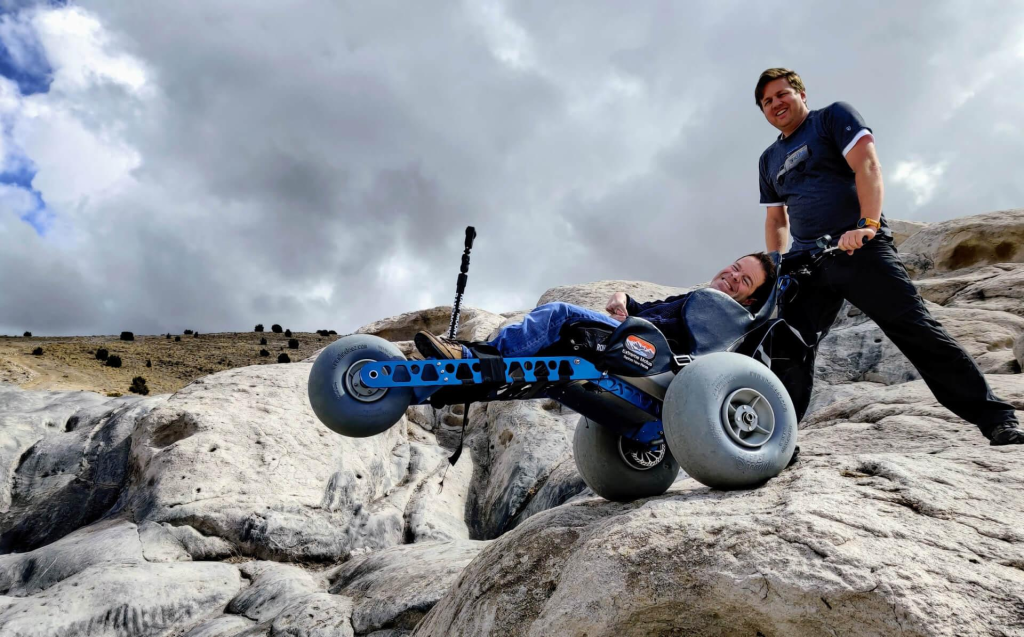
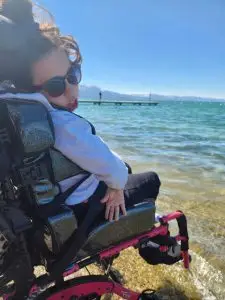
How it all started - Meet Sam & Ryan
Since 2019, Sam and Ryan have been demonstrating that nature is wheelchair accessible with the Extreme Motus All Terrain Wheelchair. From National Parks to Skateparks, their adventures prove that a manual off-road wheelchair can offer laughter and joy while navigating diverse terrains.
Join us as we continue to share these inspiring journeys.
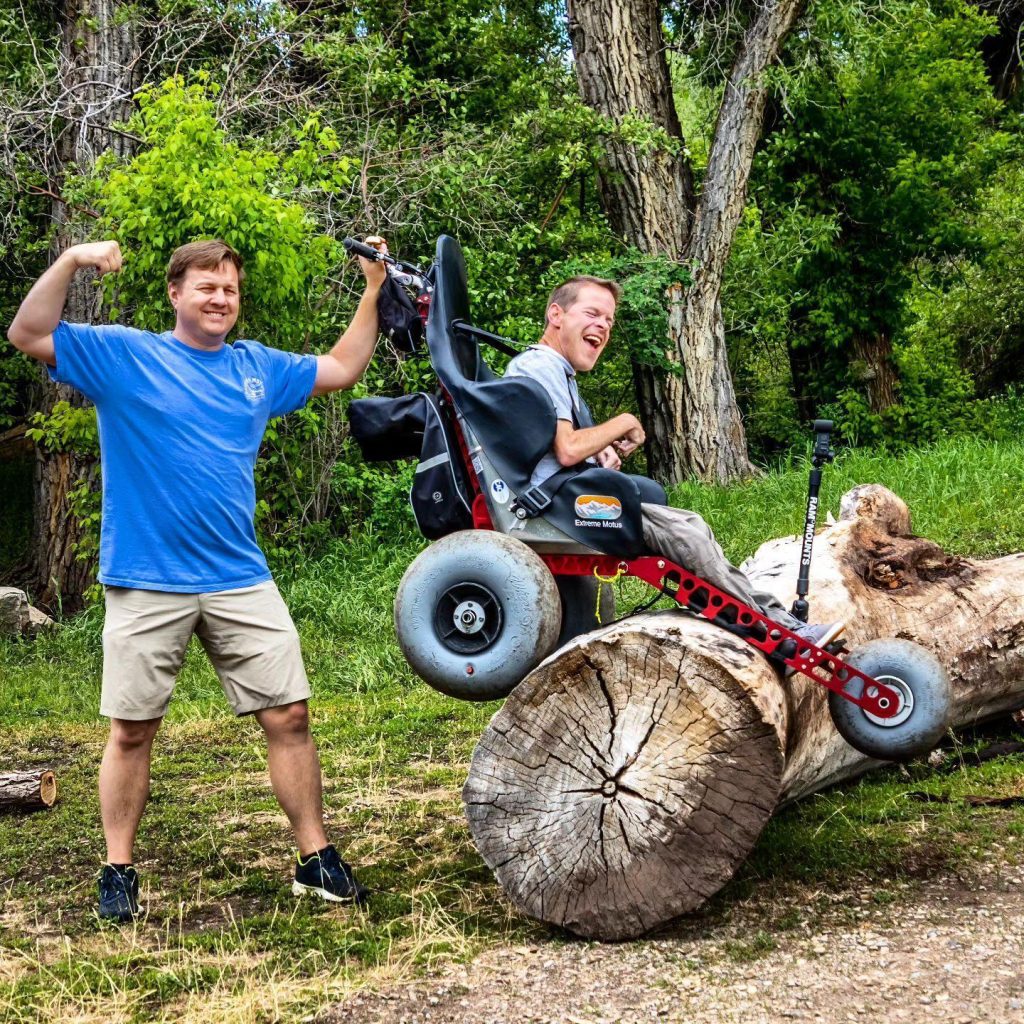
Discover Freedom with the Extreme Motus All Terrain Wheelchair
Light, comfortable, and compact, the Extreme Motus glides over sand, rocks, grass, gravel, and even floats in water.
It's more than a outdoor wheelchair; it's your ticket to freedom. Embrace the outdoors with confidence, knowing our off-road wheelchair is engineered for durability and ease of use.
Be the first to hear about new gear, upcoming adventures, and exclusive offers. As a welcome gift, you'll get a $100 coupon toward the Motus All-Terrain Wheelchair — delivered straight to your inbox.
By subscribing you agree to receive marketing communications from Extreme Motus, including product updates, promotions, and special offers. I understand I can unsubscribe at any time.