

Short answer: sometimes. A VA all-terrain wheelchair is a real possibility. The VA can and does provide these chairs to veterans, but only when a VA clinician decides the chair is part of your medical treatment and rehabilitation. “I want to get back on the trail” is a great reason to ask. On its own, though, it isn’t the reason that gets a request approved.
I’m a veteran myself, and I’ve spent years at Extreme Motus answering this exact question from other vets. This guide covers what the rules actually say, who to talk to, and what to do if the VA says no.
This is a plain-English guide, not official VA guidance. Eligibility and approvals are decided by your VA care team and your local Prosthetic & Sensory Aids Service (PSAS) office.
What the VA Rules Actually Say
The VA’s rule on prosthetic and rehabilitative items is 38 CFR § 17.3230. It lists the categories of equipment the VA can provide to eligible veterans. Two of them matter here:
- Mobility aids
- Adaptive recreation equipment
So all-terrain and recreational chairs aren’t excluded by category. The catch is the standard every item has to meet. The VA provides an item when it is clinically needed and it:
- Serves as a “direct and active component” of your medical treatment and rehabilitation, and
- Doesn’t solely support your comfort or convenience.
When the VA finalized this rule in December 2020, it addressed both of our topics head-on:
- On all-terrain chairs: The VA used “an all-terrain powered wheelchair that could allow the veteran to navigate natural obstacles” as an example of equipment the standard would not prevent it from providing.
- On recreation: The VA said it “will not provide adaptive recreation equipment solely because the equipment supports the veteran’s participation in an activity for personal enjoyment.” It also said a sports-related item that meets the medical necessity standard can be provided.
Translation: A VA all-terrain wheelchair gets approved when it’s tied to your rehab goals, such as mobility, independence, physical activity and mental health. It won’t approve one simply because it would be fun. That’s why how you frame the request, and who backs it, matters so much.
It Has Happened: A Real Example
In 2022, VA News reported on Bobby Boehm, a Marine Corps veteran (1985–1995) treated at the West Texas VA Health Care System. He wanted to get back to hunting and fishing, so he asked his VA recreational therapist about an all-terrain tracked chair. After several assessments and evaluations, he was approved.
His words: “I thought there was no way this could happen to me. But my wife encouraged me to ask, so I did.”
That’s the lesson. A lot of veterans never ask.
How to Request a VA All-Terrain Wheelchair
1. Start with your care team, not a catalog
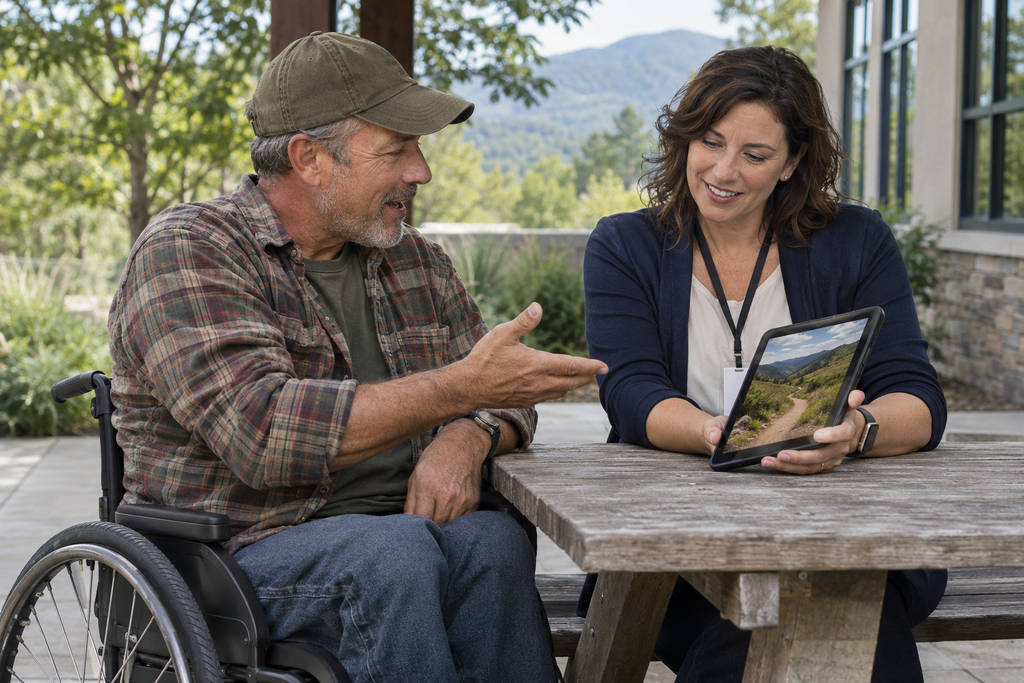
Bring it up with your VA primary care provider, a physical medicine & rehabilitation (PM&R) physician, a physical or occupational therapist, or a recreation therapist. Equipment requests go through a clinician, who submits them to your facility’s Prosthetic & Sensory Aids Service (PSAS).
2. Frame it around your treatment goals
Explain how the chair supports your rehab plan. For example:
- Getting enough physical activity when standard chairs can’t handle gravel, grass, sand or dirt
- Independence and access to the places you’d otherwise be stuck watching from the parking lot
- Mental health benefits of time outdoors (we’ve written about the health benefits of getting outside)
- Participating in VA or community adaptive sports and recreation programs
3. Expect an evaluation
Like Boehm, you’ll likely go through assessments covering your mobility, your goals and the environments you’ll use the chair in. Be specific about the terrain you actually face.
4. Bring product information
For a VA all-terrain wheelchair request, your clinician will want to know what the chair does, what it weighs and how it’s configured. For the Extreme Motus all-terrain wheelchair, these are good places to start:
- Meet the Extreme Motus Off-Road Wheelchair: The Complete Guide
- How Much Does It Weigh? (55 lbs)
- Sizing & Custom Options
Need a spec sheet or quote for your care team? Contact us and we’ll send what they need.
5. Ask about follow-up if it’s denied
If the answer is no, ask your clinician why, and whether a different justification, a different type of chair or a reassessment would change it.
Manual or Powered? It Changes the Conversation
All-terrain chairs come in two broad types:
- Powered tracked chairs are heavy, motorized and built for self-driving over rough ground. These are what most VA news stories feature.
- Manual all-terrain chairs like the Extreme Motus are lighter, simpler and easy to load into a vehicle. They’re built for getting out on trails, beaches and snow with a buddy or family member along.
Which one fits depends on how you’ll use it, your function and who’s going with you. We break down the tradeoffs in Manual vs. Powered All-Terrain Wheelchairs and our 10-Factor Buyer’s Guide. Share both with your care team.
If the VA Says No: Other Ways to Get Rolling
A denial doesn’t mean you’re stuck inside. Here are your other options.
VA Adaptive Sports Grant programs
In October 2026, the VA awarded $16 million in Adaptive Sports Grants to 91 community-based organizations that run programs for veterans with disabilities, from fishing and hunting to cycling and skiing. Many of these programs have adaptive equipment you can use. Ask your local VA recreation therapist which grantees operate near you.
Borrow one for free
Dozens of parks, nature centers and preserves now loan all-terrain wheelchairs at no cost, including all five of Utah’s national parks. Find one near you on our All-Terrain Wheelchair Loaner Map.
Grants for the chair itself
Veteran service organizations and disability nonprofits regularly fund adaptive equipment. Start with our 11 Best Grants for All-Terrain Wheelchairs.
Financing
If you’d rather not wait, see Can I Finance an Extreme Motus All-Terrain Wheelchair? and our All-Terrain Wheelchair Price Guide.
Medicare (if you have it)
Some veterans also carry Medicare. Here’s what that covers, and what it doesn’t: 5 Medicare-Approved Wheelchairs.
Frequently Asked Questions
Can I get a VA all-terrain wheelchair?
You can. Under 38 CFR § 17.3230, the VA provides mobility aids and adaptive recreation equipment when a clinician determines the item is a direct and active part of your treatment and rehabilitation, and not solely for comfort or convenience.
Who do I ask about a VA all-terrain wheelchair?
Start with your VA primary care provider, PM&R physician, physical or occupational therapist, or recreation therapist. They submit equipment requests to your facility’s Prosthetic & Sensory Aids Service (PSAS).
Will the VA buy an all-terrain wheelchair just for hiking or fishing?
Not for enjoyment alone. The VA has said it won’t provide adaptive recreation equipment solely so a veteran can take part in an activity for personal enjoyment. Requests tied to rehab goals like physical activity, independence and mental health have a stronger case.
Do I need a service-connected disability?
Eligibility for VA prosthetic items depends on your VA health care enrollment and individual circumstances. Your local PSAS office can tell you what applies to you.
What if my request is denied?
Ask your clinician for the reason and whether a reassessment or different justification could help. Meanwhile, look into VA Adaptive Sports Grant programs, free loaner chairs, grants and financing.
The Bottom Line
You earned your VA benefits, and that can include equipment that gets you back outside. The path runs through your care team, and the request is strongest when it’s tied to your treatment goals.
So ask. Worst case, you hear “no” and move on to plan B. Best case, you’re back on the trail.
Questions about the Extreme Motus all-terrain wheelchair, or need product info to support a VA all-terrain wheelchair request? Get in touch. We’re happy to help.
Sources: 38 CFR § 17.3230 (Cornell LII); Federal Register, “Prosthetic and Rehabilitative Items and Services,” Dec. 28, 2020; VA News, “Therapy provides Marine Corps Veteran all-terrain trackchair,” May 2022; The American Legion, “VA awards $16 million in grants for adaptive sports programs,” Oct. 2026.
How it all started - Meet Sam & Ryan
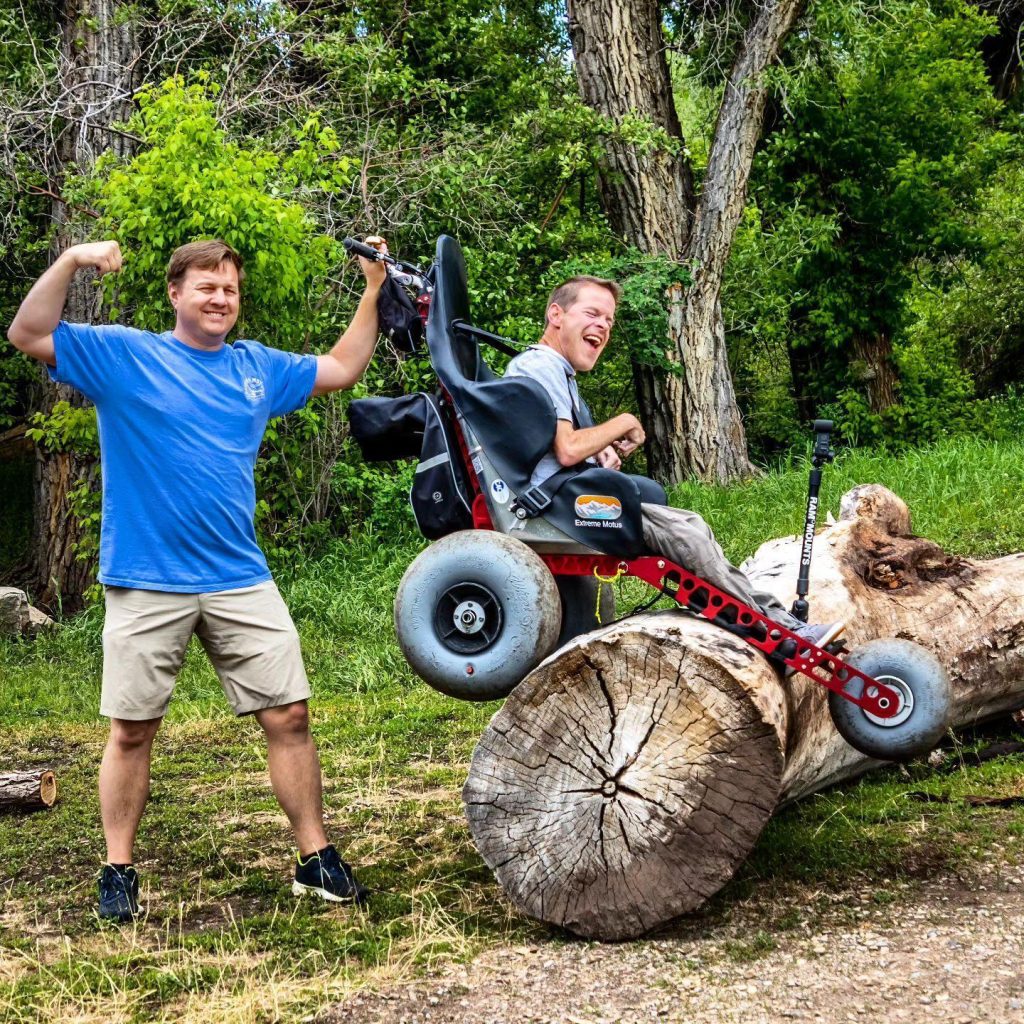
Since 2019, Sam and Ryan have been demonstrating that nature is wheelchair accessible with the Extreme Motus All Terrain Wheelchair. From National Parks to Skateparks, their adventures prove that a manual off-road wheelchair can offer laughter and joy while navigating diverse terrains.
Join us as we continue to share these inspiring journeys.
Discover Freedom with the Extreme Motus All Terrain Wheelchair
Light, comfortable, and compact, the Extreme Motus glides over sand, rocks, grass, gravel, and even floats in water.
It's more than a outdoor wheelchair; it's your ticket to freedom. Embrace the outdoors with confidence, knowing our off-road wheelchair is engineered for durability and ease of use.
Be the first to hear about new gear, upcoming adventures, and exclusive offers. As a welcome gift, you'll get a $100 coupon toward the Motus All-Terrain Wheelchair — delivered straight to your inbox.
By subscribing you agree to receive marketing communications from Extreme Motus, including product updates, promotions, and special offers. I understand I can unsubscribe at any time.